Gramosoft Insights
Scraping Insights For Modern AI Data
Discover strategies for structured data, crawling, scraping, LLMs, and RAG to build smarter and more efficient data workflows.

Latest Articles
Best AI Web Scrapers in 2026
The best AI web scrapers in 2026 compared: GcrawlAI, Firecrawl, Crawl4AI, Apify, ScrapeGraphAI, Browse AI, Thunderbit, Octoparse, Kadoa and Bright Data, with what counts as an AI scraper, entry prices and billing units, our own lab of what six page-to-Markdown routes hand to a model (plain HTTP and Crawl4AI defaults kept 6 of 12 facts; waiting for JavaScript and filtering kept 12 of 12 at half the words; a saved CSS schema returned 0 of 20 rows after a redesign while reporting success), how to test a scraper before trusting it, cost and choice tables.
Best RAG Frameworks in 2026
The best RAG frameworks in 2026 compared: GsearchAI as a ready-made enterprise platform combining graph RAG and vector RAG, then LangChain with LangGraph, LlamaIndex, Haystack, DSPy, RAGFlow, LightRAG, Microsoft GraphRAG, txtai, Cognee, Mastra and Microsoft Agent Framework, with licences, maintenance status, install footprint and import times, evaluation options, our own loader lab (every default web loader lost the same six JavaScript-built pages; rendered Markdown took retrieval from 6 to 11 or 12 of 12), cost, and where GcrawlAI fits as the ingestion step.
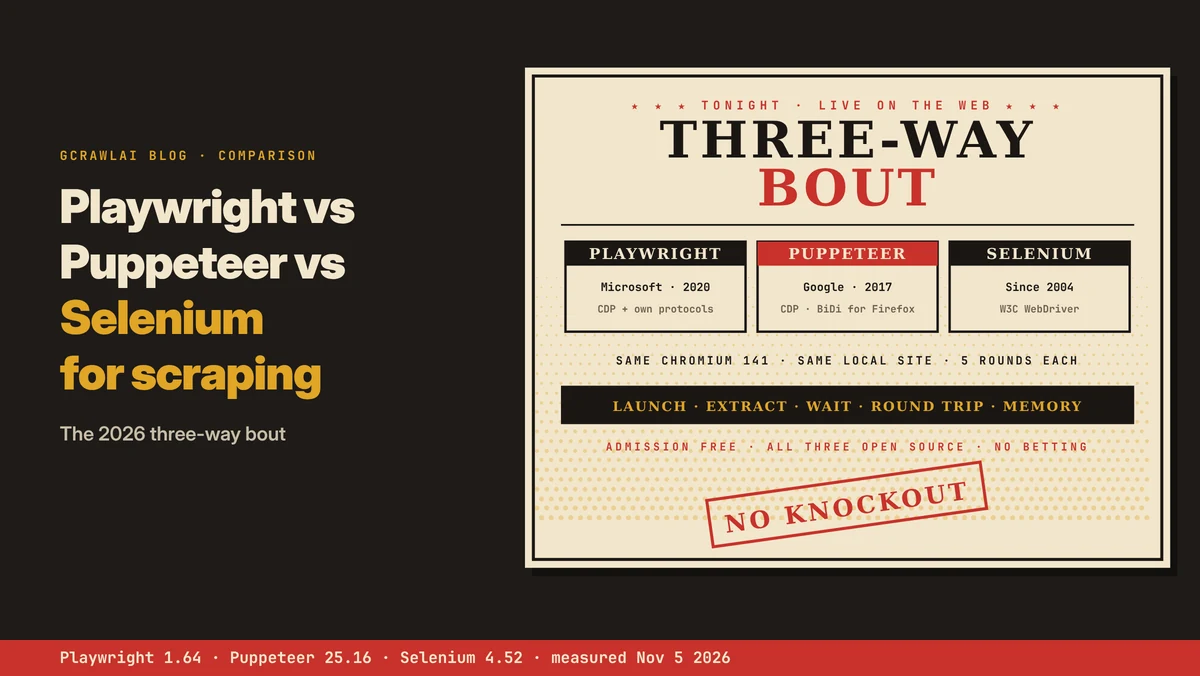
Playwright vs Puppeteer vs Selenium for Web Scraping (2026)
Playwright vs Puppeteer vs Selenium for web scraping in 2026: how each talks to the browser (CDP, its own protocols, W3C WebDriver), browser and language coverage, how each waits for elements, a first Playwright scrape, our own side-by-side lab on the same Chromium 141 (launch time, extraction, waits, per-command round trip of 1.0 ms for Puppeteer, 2.2 to 2.6 ms for Playwright and 9.0 ms for Selenium, memory including Playwright Python's 169 MB Node driver), running them at scale, cost, and when GcrawlAI is the simpler route.
Camoufox Tutorial: Scrape Without Getting Detected
A Camoufox tutorial for 2026: what the open-source Firefox build for scraping is and how it sets fingerprint values in the engine, when it is the right tool, how to install it (the browser is a separate download from GitHub), a first Playwright-style scrape with a content check, proxies with geoip, what our own install audit of camoufox 0.5.9 found (browser 158.0.1-beta.41, Playwright 1.62, 285 fingerprint presets, a fetch that fails where GitHub is blocked), the limits to plan around, and when GcrawlAI is the simpler route.
Nodriver and Undetected ChromeDriver: Python Tutorial
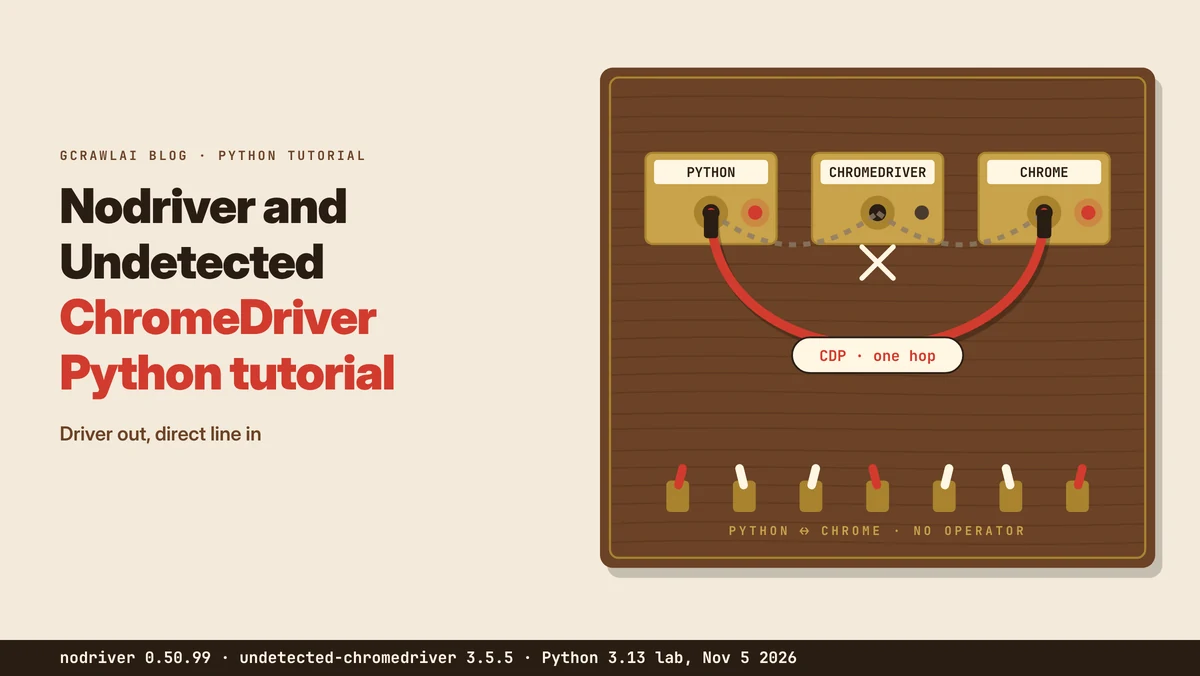
A Python tutorial for nodriver and undetected-chromedriver in 2026: how the patched-ChromeDriver approach and the driverless CDP approach differ, where each project stands (undetected-chromedriver 3.5.5 frozen since February 2024, nodriver 0.50.99 from October 2026, the zendriver fork), how to install both (the distutils import failure on Python 3.12+ and the setuptools workaround), a first nodriver scrape, the quiet migration traps (select() returning None, .text versus .text_all, JPEG screenshots), our own lab results on Python 3.13 and Chromium 141, the limits, and when GcrawlAI is the simpler route.
WebRTC and DNS Leaks: Why Your Proxy Still Exposes Your Scraper
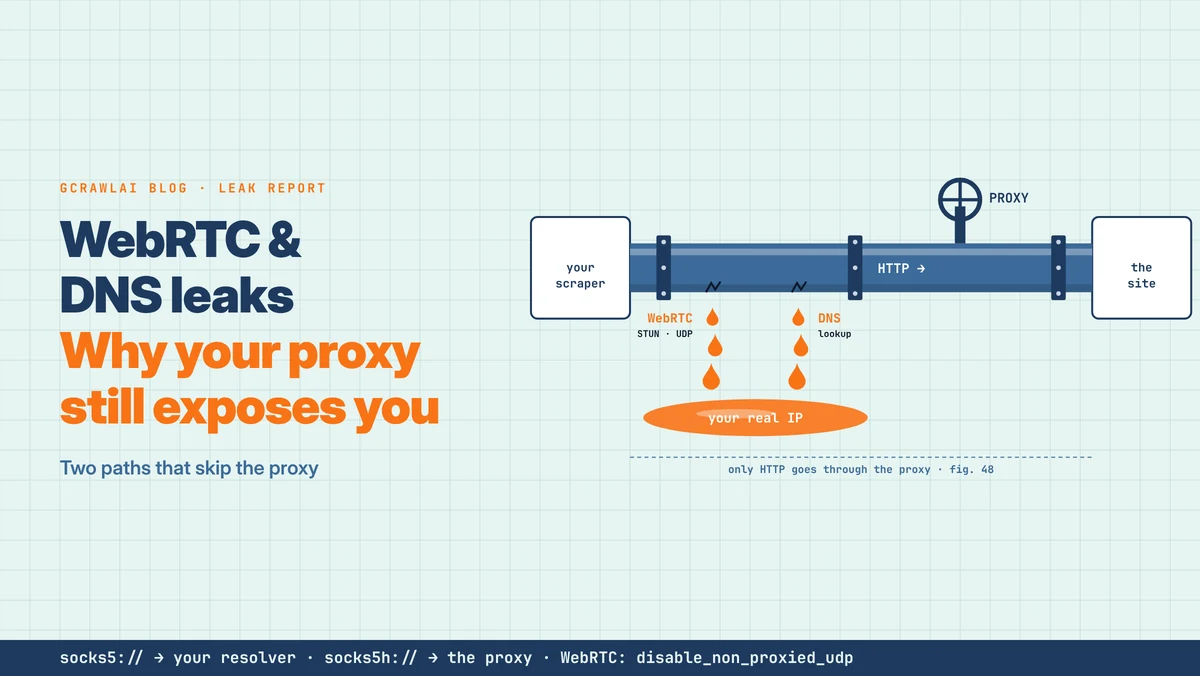
Why a working proxy can still expose your scraper: WebRTC STUN requests travel over UDP outside HTTP and SOCKS proxies and show a page your own address, and socks5:// in requests or curl resolves hostnames on your machine. What our local lab measured (requests socks5:// made a local lookup, socks5h:// and httpx did not; Chromium sent STUN directly through both proxies; the --force-webrtc-ip-handling-policy flag did nothing in Chromium 141 while the same preference stopped the leak), a script to check your own browser, the fixes, and where GcrawlAI fits.