By Rajesh Kannan, Co-Founder & CTO, Gramosoft · Last updated: · Scrapfly pricing and billing rules checked on scrapfly.io and its docs on November 1, 2026; other prices checked on each vendor's own pages between October 27 and November 1, 2026
Scrapfly is a capable scraping platform, but a page's price depends on choices made per request. A datacenter page costs 1 credit, a rendered residential page 30, and its Unblocker can switch the proxy pool or turn on a browser, with some shield fees it doesn't publish. This guide ranks nine alternatives, starting with GcrawlAI, where every page is one request.
TL;DR
- Best overall: GcrawlAI. One request per page on every site, with rendering, residential IPs and anti-bot included, failed requests never charged, a Python SDK, MCP for AI agents and an MIT core you can self-host.
- How Scrapfly bills: datacenter 1 credit, JavaScript rendering +5, residential 25, a full-page screenshot 60, plus bandwidth on responses over 1 MB. The Unblocker's cost "may fluctuate", some targets carry shield fees, and 404 responses are billed.
- Like-for-like APIs: ScrapingBee and ZenRows for published multipliers, ScraperAPI for parsed Amazon and Google data, ScrapingAnt for cheap unprotected pages.
- Other shapes: Bright Data and Oxylabs for enterprise networks, Zyte for Scrapy teams, Firecrawl for Markdown.
- Honest cost note: at 10,000 protected pages a month, Zyte's cheapest tier and Bright Data's Web Unlocker cost less than GcrawlAI's $29, and when Scrapfly's Unblocker clears a site on datacenter IPs, its 5-credit page is cheaper than ours.
What is the best Scrapfly alternative? For most teams it's GcrawlAI: a scraping API with a Python SDK, MCP for AI agents and a self-hostable MIT core, where every page costs one request whatever it needs and failed requests are free. There's no proxy pool, render flag or Unblocker escalation to price, so a protected page costs the same as a plain one, and you know the cost before you send it.
Quick comparison (details and sources for each tool follow)
| Tool | Type | Best for | Billing unit | Free plan |
|---|---|---|---|---|
| GcrawlAI | Scraping API, SDK, MCP, open source | Protected and JavaScript sites, AI agents, predictable bills | Request (all features included) | 50 requests/month, no card |
| ScrapingBee | Scraping API | Published multipliers, extraction rules | Credit (1 to 75 per page) | 1,000 credits once |
| ZenRows | Scraping API + scraping browser | Fixed multipliers you can model | Credit (1 to 25 per page) | 5,000 credits/month |
| ScraperAPI | Scraping API + structured endpoints | Parsed Amazon and Google data | Credit (1 to 75 per page) | 1,000 credits/month |
| ScrapingAnt | Scraping API | Cheap unprotected pages | Credit (1 to 125 per page) | 10,000 credits/month |
| Bright Data | Web Unlocker, proxies, datasets | A flat rate per successful request | Successful request | 5,000 requests/month |
| Oxylabs | Web Scraper API, proxies | Enterprise network, shared balance | Result, by target and JavaScript | $5 credit |
| Zyte | Scraping API + Scrapy Cloud | Teams standardised on Scrapy | Response, by site tier | $5 credit |
| Firecrawl | Scraping API | Markdown for LLM apps | Credit (1 per page, more for JSON) | 1,000 credits/month |
The 9 best Scrapfly alternatives in 2026
These nine tools cover the reasons teams leave Scrapfly: a page that can cost 1 credit or 30 depending on the pool and rendering, an Unblocker whose cost can change as sites change, shield fees that appear only in the log, and credits that reset every month. They're ranked by how well each replaces Scrapfly, with GcrawlAI first.
1. GcrawlAI: one request per page, no credit stack
Best for: teams scraping protected or JavaScript-heavy sites who want a bill they can predict, plus RAG pipelines and AI agents · License: MIT core, managed Cloud API · Language: Python SDK (gcrawl-sdk 0.5.8), REST, MCP
GcrawlAI does what a Scrapfly request with the Unblocker does, without the settings that change the price. Every page goes through a real browser and residential IPs, and Cloudflare, DataDome, Akamai and PerimeterX are handled on the way. That's one request, whether the page is a blog post or a protected product page. A blocked page, CAPTCHA, timeout or server error isn't billed.
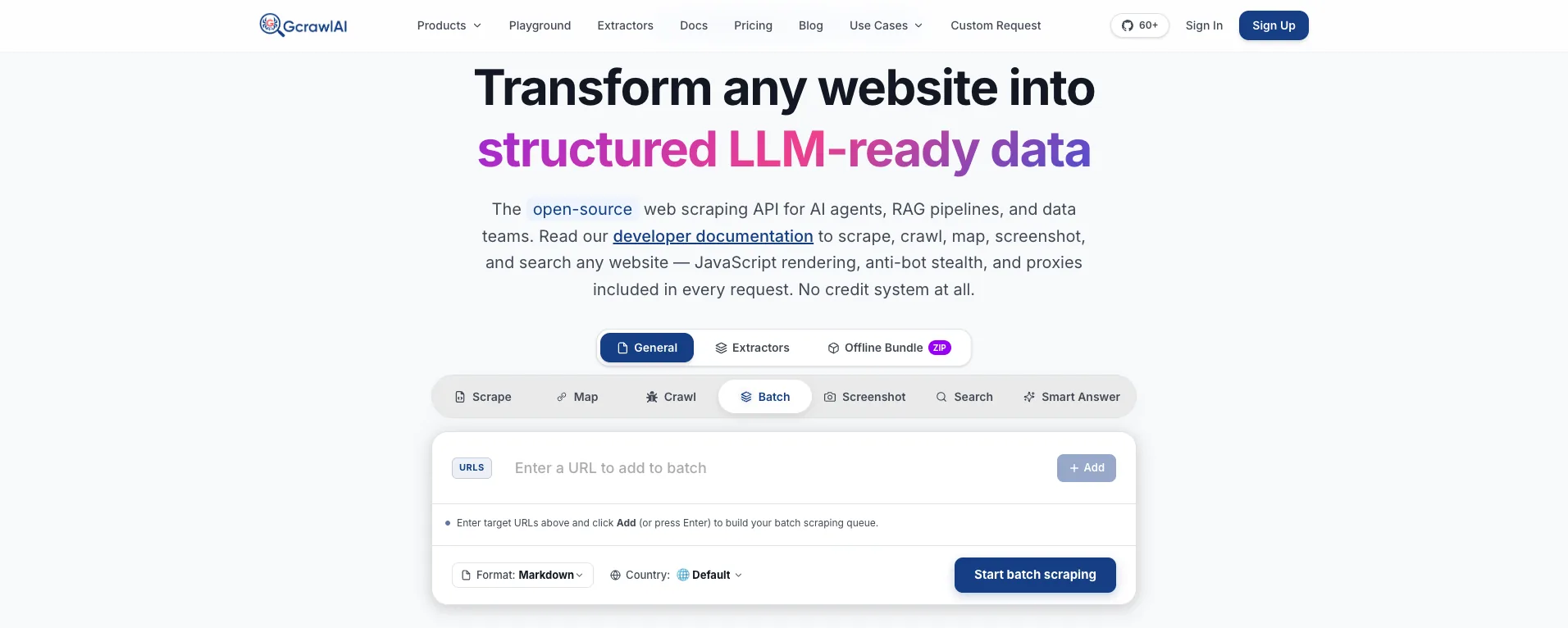
The homepage says it plainly: JavaScript rendering, anti-bot stealth and proxies are included in every request, with no credit system at all. The Batch tab shown above takes a list of URLs, a format (Markdown by default) and a country, and runs them as one job, much like a Scrapfly crawl or batch with webhooks.
- Scrape, crawl and map: scrape a page into HTML, Markdown or JSON, crawl a site with depth control and duplicate filtering, or map its URLs first, the jobs Scrapfly's Crawler API covers.
- Bulk jobs: batch runs and async jobs with webhooks.
- Search and Deep Search: a Search API at one request per results page, and Deep Search, which merges several engines into one list.
- Extractors: ready-made structured data for common targets, and custom extractors for your own sites through a custom request, in place of Scrapfly's Extraction API.
- Screenshots and offline bundles: screenshots on mobile, tablet and desktop, where Scrapfly charges 60 credits for a full-page screenshot, and offline HTML bundles for audits.
- Agents and testing: an MCP server for Claude, Cursor and other agents, the Playground, a free proxy list, and the docs.
A rendered page through residential IPs, a whole-site crawl and a search, each priced as one request per page:
# pip install gcrawl-sdk
from gcrawl_sdk import GcrawlClient, ScrapeOptions

client = GcrawlClient(api_key="gc-YOUR_API_KEY")   # or GCRAWL_API_KEY; base_url="http://localhost:8000" when self-hosted

if __name__ == "__main__":
    # One page, rendered, through residential IPs: one request. No asp, proxy_pool or render_js choice that changes the price.
    page = client.scrape(
        url="https://www.example-shop.com/product/123",
        options=ScrapeOptions(html_enabled=True, markdown_enabled=True, proxy_geo="US", auto_scroll=True),
        wait=True,
    )
    print(len(page.html or ""), "bytes of rendered HTML")   # for your own selectors
    print(page.markdown[:300])                              # LLM-ready Markdown

    # A whole-site crawl: every page one request, however long it takes to render.
    job = client.crawl(url="https://docs.example.com/", limit=200, formats=["markdown"], wait=True)
    print(job.status, len(job.pages), "pages,", job.pages_failed, "failed (not billed)")

    # Ranked search results, one request per page of results.
    hits = client.search(query="best running shoes 2026", pagination=1, geo="US")
    for r in hits.results[:3]:
        print(r.position, r.title, r.url)
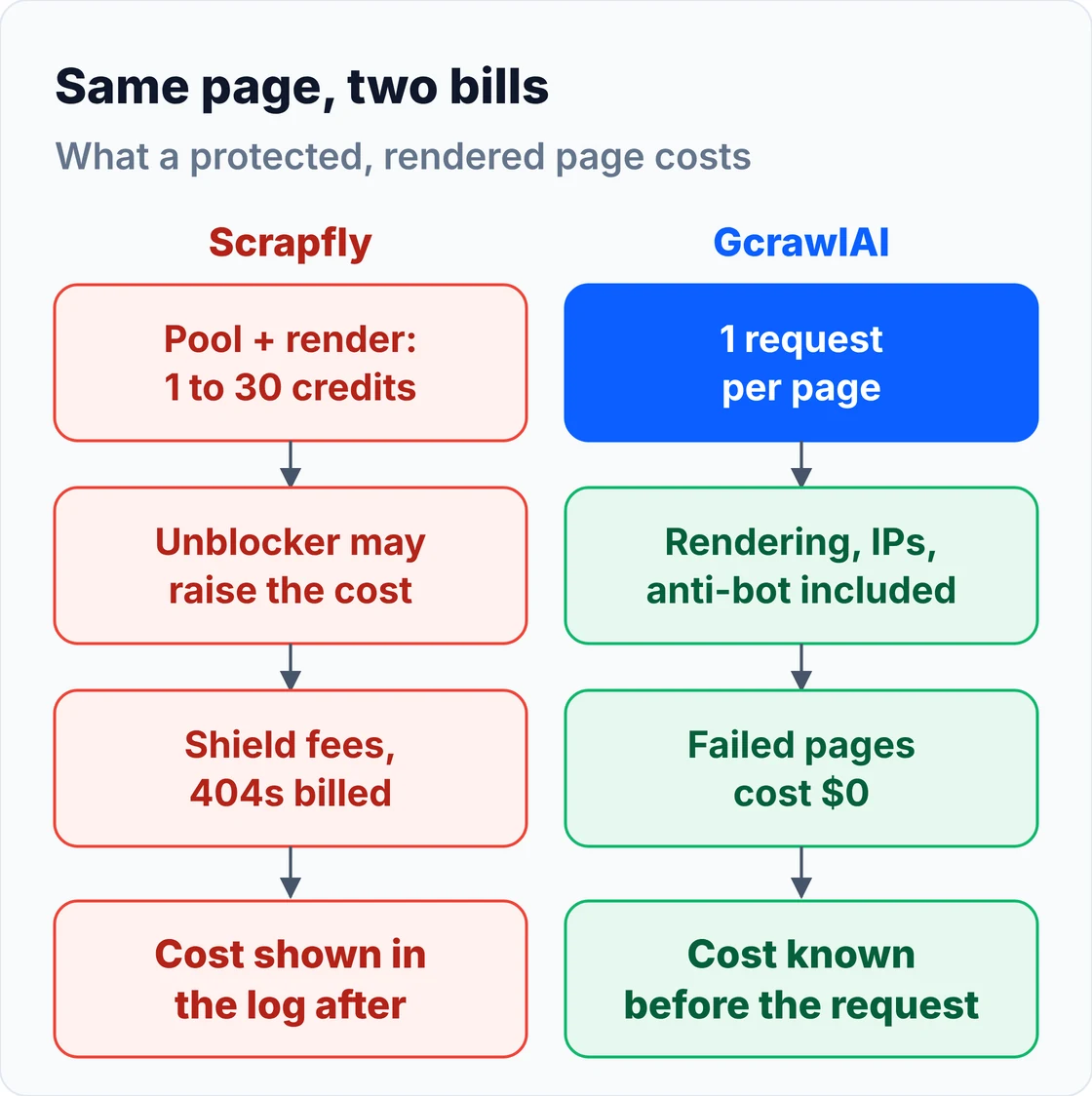
The diagram shows why the two bills behave differently. On Scrapfly the pool, rendering and the Unblocker set the credits, and the final cost appears in the log; on GcrawlAI the same page is one request either way.
And the self-hosted core, for data that must stay on your own servers:
git clone https://github.com/GramosoftAI/GcrawlAI.git && cd GcrawlAI
python -m venv .venv && source .venv/bin/activate
pip install -r requirements.txt && playwright install
cp .env.example .env                      # add your database, Redis and proxy settings
python -m api.core.db_setup
redis-server &
celery -A web_crawler.crawler.celery_config worker -l info &
uvicorn api.api:app --port 8000
Pricing (GcrawlAI pricing, checked October 28, 2026):
| Plan | Price | Requests/month | Per 1,000 |
|---|---|---|---|
| Free | $0 forever, no card | 50 | – |
| Starter | $29/month | 20,000 | $1.45 |
| Growth (most popular) | $79/month | 80,000 | $0.99 |
| Pro | $199/month | 250,000 | $0.80 |
| Scale | $499/month | 750,000 | $0.67 |
| Enterprise | Volume pricing | 2M+ | Custom |
| Self-hosted | $0 (MIT) | Your servers | Infrastructure only |
Every page is one request on every site, failed requests are never charged, and unused requests on paid plans roll over once, where Scrapfly's quota resets at each renewal.
Where it falls short: there's no hosted cloud browser for long multi-step sessions, which Scrapfly offers, and no SDKs for Go or Rust yet. Plain pages that clear on datacenter IPs cost less on Scrapfly, at 1 credit. The ecosystem is younger, and self-hosting means bringing your own proxy accounts.
"If the price of a page can change after you send it, you can't really budget. We decided the browser, the residential IP and the retries belong inside one request, so a hard page costs what an easy one does."
Rajesh Kannan, Co-Founder & CTO at Gramosoft
2. ScrapingBee: published multipliers, more credits
Best for: small teams that want an easy API with extraction rules and screenshots · Type: scraping API with JavaScript rendering, proxies, AI extraction and dedicated scraper APIs
ScrapingBee's credit costs are fixed and published, so there's no escalation to watch for: you pick the proxy tier and know the price. Its $19 Hobby plan sits below Scrapfly's $30 Discovery. More in our ScrapingBee alternatives guide.
Pricing (ScrapingBee plans, checked November 1, 2026; credit costs):
| Plan | Price/month | Credits | Concurrent |
|---|---|---|---|
| Free trial | $0 | 1,000 (once) | – |
| Hobby | $19 | 75,000 | 25 |
| Freelance | $49 | 250,000 | 50 |
| Startup | $99 | 1,000,000 | 100 |
| Business | $249 | 3,000,000 | 200 |
| Business+ | $599 | 8,000,000 | 400 |
JavaScript rendering costs 5 credits, premium proxies 10 (25 with JavaScript) and stealth proxies 75.
Where it falls short: a stealth page costs 75 times a plain one, credits don't roll over, and the free credits are a one-time trial.
3. ZenRows: fixed multipliers you can model
Best for: teams who want to know the cost of a hard page before they send it · Type: scraping API with SDKs, a scraping browser and an MCP server
ZenRows prices by the features a request uses, with a top rate of 25 credits for JavaScript plus premium proxies. That's below Scrapfly's 30 for residential with rendering, and there are no target-specific fees. More in our ZenRows alternatives guide.
Pricing (ZenRows pricing, checked October 27, 2026):
| Plan | Price/month | Credits |
|---|---|---|
| Free | $0 | 5,000 a month |
| Build | $19 to $39 | 45,000 to 120,000 |
| Launch | $69 to $129 | 250,000 to 700,000 |
| Growth | $199 to $399 | 1.2 million to 3 million |
| Request type | Credits per page |
|---|---|
| Standard | 1 |
| JavaScript rendering | 5 |
| Premium proxy | 10 |
| JavaScript + premium proxy | 25 |
Where it falls short: a rendered page on premium proxies still costs 25 times a plain one, and credits don't roll over.
4. ScraperAPI: parsed Amazon and Google data
Best for: teams that want structured JSON for marketplaces and Google, and a no-code scheduler · Type: scraping API with structured endpoints, async jobs and DataPipeline
ScraperAPI's structured endpoints return parsed JSON for Amazon, Walmart and Google, where Scrapfly needs its separate Extraction API. Its credit costs are fixed per domain and parameter, so they don't move with the target's protection the way the Unblocker can.
Pricing (ScraperAPI pricing, credit costs, checked November 1, 2026):
| Plan | Price/month | Credits | Geotargeting |
|---|---|---|---|
| Free | $0 | 1,000 a month (after a 7-day, 5,000-credit trial) | – |
| Hobby | $49 | 100,000 | US and EU |
| Startup | $149 | 1,000,000 | US and EU |
| Business | $299 | 3,000,000 | All countries |
| Scaling | $475 | 5,000,000 | All countries |
A standard page is 1 credit, rendering 10, premium proxies with rendering 25, ultra premium with rendering 75, Google 25 and LinkedIn 30, and a bot bypass adds 10.
Where it falls short: 200 and 404 responses are both billed, the cheaper plans target only the US and EU, and credits reset at renewal. More in our comparison of the cheapest reliable scraping APIs.
5. ScrapingAnt: cheap unprotected pages
Best for: high volumes of unprotected pages, where its large credit allowances go furthest · Type: scraping API with Markdown, AI extraction and an MCP server
ScrapingAnt gives the most credits per dollar in this list and a recurring free plan of 10,000 credits a month. Only successful responses are charged, with no failure-rate threshold like Scrapfly's 30% rule. The catch is residential routing, which costs far more credits.
Pricing (ScrapingAnt plans and credit costs, checked November 1, 2026):
| Plan | Price/month | Credits |
|---|---|---|
| Free | $0 | 10,000 a month (1 concurrent request) |
| Enthusiast | $19 | 100,000 |
| Startup | $49 | 500,000 |
| Business | $249 | 3,000,000 |
| Business Pro | $599 | 8,000,000 |
| Request type | Credits per page |
|---|---|
| Plain HTTP, datacenter | 1 |
| JavaScript rendering, datacenter | 10 |
| Residential, no rendering | 25 |
| Residential + rendering | 125 |
Where it falls short: a rendered residential page costs 125 credits, four times Scrapfly's 30, so it only pays off on unprotected targets.
6. Bright Data: one flat rate per request
Best for: enterprise teams that want a flat price and a large proxy network · Type: Web Unlocker API on a proxy network, plus browsers, scrapers and datasets
Bright Data's Web Unlocker charges the same list rate for every successful request, so there's no pool or render choice to price per page. More in our Bright Data alternatives guide.
Pricing (Unlocker pricing, checked October 27, 2026):
| Plan | Price | Requests included | Per 1,000 |
|---|---|---|---|
| Free tier | $0 | 5,000 a month | – |
| Pay as you go | Usage only | – | $1.50 |
| Scale | $499/month | 383,000 | $1.30 after that |
Where it falls short: there's no plan between pay as you go and $499 a month, and the product catalogue takes time to learn.
7. Oxylabs: an enterprise network on one balance
Best for: teams that want proxies and a scraping API from one vendor · Type: Web Scraper API, residential, mobile, ISP and datacenter proxies, Web Unblocker and Agent Browser
Oxylabs prices its Web Scraper API per 1,000 results by target and by JavaScript rendering, and every product draws from one monthly balance. Its rates are published per tier, with no target fees added after the request.
Pricing (Web Scraper API pricing, checked November 1, 2026):
| Plan | Price/month | Custom site with JavaScript, per 1,000 | /Scrape, per 1,000 |
|---|---|---|---|
| Welcome credits | $0 | $5 toward any product | – |
| Starter | $30 | $1.50 | $0.50 |
| Basic | $100 | $1.40 | $0.45 |
| Flexible | $500 | $1.30 | $0.35 |
| Enterprise | From $2,500 | $1.22 | $0.25 |
Where it falls short: there's a big step from $100 to $500 a month, its pricing page says self-service purchases are non-refundable, and the product catalogue is broad.
8. Zyte: for teams built on Scrapy
Best for: engineering teams whose spiders are written in Scrapy · Type: Zyte API for fetching, plus Scrapy Cloud for hosting spiders
Zyte maintains Scrapy and bills per successful response, with a price set by a tier it assigns each site. Like Scrapfly's Unblocker, the cost depends on the target, but the tier rates themselves are published.
Pricing (Zyte pricing, Zyte API pricing docs, checked October 28, 2026), pay as you go per 1,000 successful responses:
| Site tier | HTTP response | Browser-rendered |
|---|---|---|
| Tier 1 | $0.13 | $1.01 |
| Tier 3 | $0.44 | $4.02 |
| Tier 5 | $1.27 | $16.08 |
Where it falls short: you don't know a site's tier until you've sent requests, and a rendered page on a Tier 5 site costs 16 times one on Tier 1.
9. Firecrawl: Markdown for LLMs
Best for: pages that go straight into a model or vector store · Type: scrape, crawl, map and search API with an AGPL open-source core
Firecrawl returns clean Markdown by default and prices most pages at one credit whatever the protection, with crawling and site mapping built in. We compared it with GcrawlAI in our Firecrawl alternatives guide.
Pricing (Firecrawl pricing, billing docs, checked October 27, 2026):
| Plan | Price/month | Credits |
|---|---|---|
| Free | $0 | 1,000 a month |
| Hobby | $19 | 5,000 |
| Standard | $99 | 100,000 |
| Growth | $399 | 500,000 |
Where it falls short: JSON output adds 4 credits, pages that return 403 or 404 still cost a credit, and there's nothing between $19 and $99.
How Scrapfly pricing works
Scrapfly sells monthly credit quotas, and a request's cost is built from the proxy pool, JavaScript rendering, the Unblocker and the response size. These rules come from Scrapfly's pricing page and its billing and Unblocker docs, checked November 1, 2026. Quotas reset at renewal, and unused credits don't roll over.
Plans (Scrapfly pricing):
| Plan | Price/month | Credits | Concurrent | Extra credits |
|---|---|---|---|---|
| Free | $0 | 1,000 on signup | – | – |
| Discovery | $30 | 200,000 | 5 | None (stops at the quota) |
| Pro | $100 | 1,000,000 | 20 | $3.50 per 10,000 |
| Startup | $250 | 2,500,000 | 50 | $2.00 per 10,000 |
| Enterprise | $500 | 5,500,000 | 100 | $1.20 per 10,000 |
What a request costs (billing docs):
| Request | Credits |
|---|---|
| Datacenter proxy | 1 |
| Residential proxy | 25 |
JavaScript rendering (render_js) |
+5 |
| Full-page screenshot | 60 |
| Bandwidth past 1 MB (3 MB with rendering) | 3 per 100 KB on datacenter, 10 on residential |
| Unblocker | Varies: can switch the pool or add a browser, plus some unpublished shield fees |
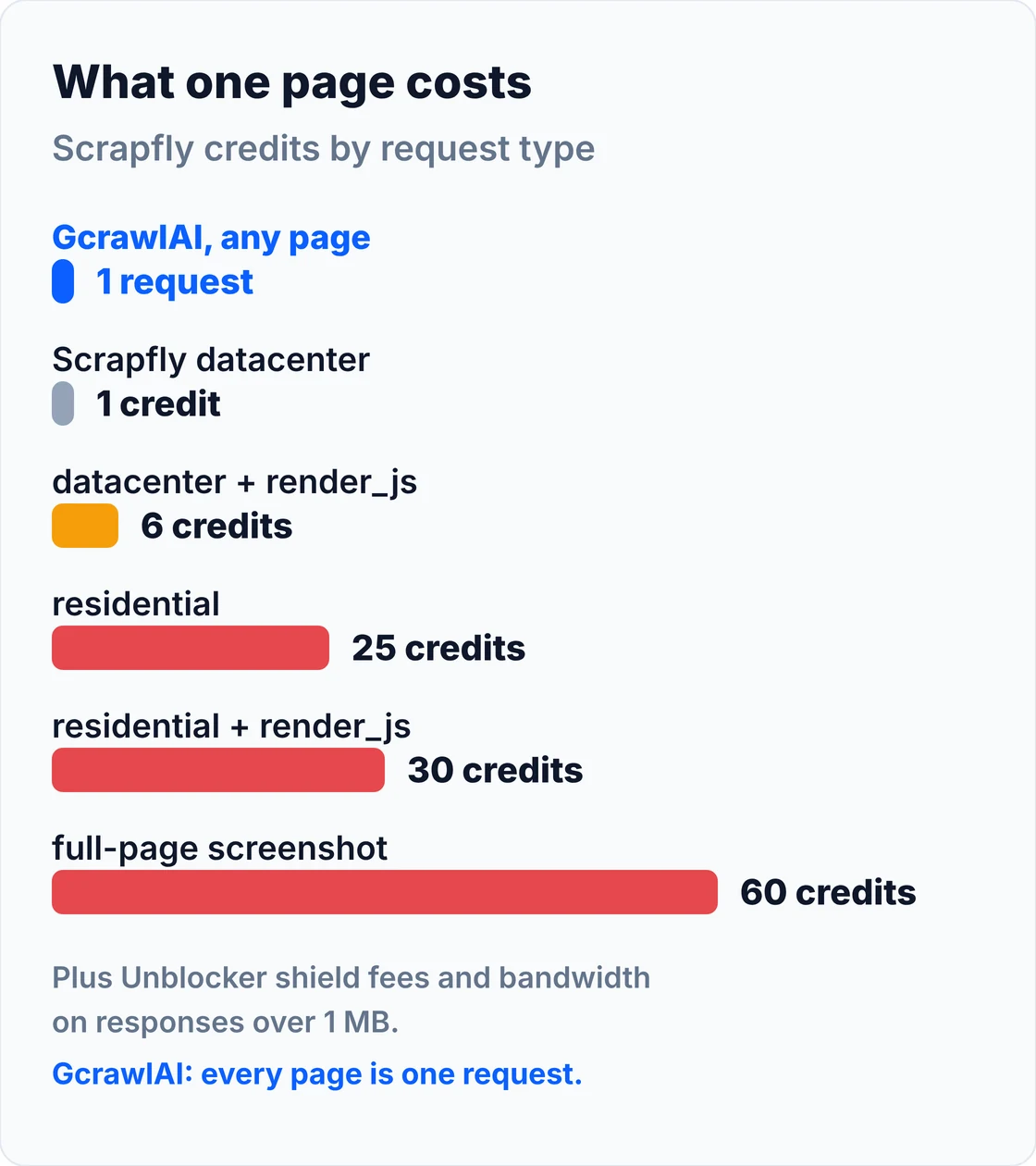
Scrapfly's Unblocker docs say its credit cost "may fluctuate" when a site adds protection, and that some targets carry fees that aren't publicly documented, shown in the cost section of your log. Failed scrapes are free, but 404s are billed, and if 30% or more of your scrapes in 24 hours are blocked without the Unblocker, failed scrapes start to bill.
What 10,000 and 100,000 protected pages a month cost
For protected pages that need residential IPs and a browser, GcrawlAI costs $29 for 10,000 and $101 for 100,000, on any site. Scrapfly costs $100 and $350 at 30 credits a page, before any shield fee or bandwidth charge. The table shows the cheapest published plan for each tool where a fixed rate exists.
| Tool (how a protected, rendered page is billed) | 10,000 pages/month | 100,000 pages/month |
|---|---|---|
| GcrawlAI (1 request, any site) | $29 (Starter) | $101 (Growth + overage) |
| Scrapfly (residential + JavaScript, 30 credits) | $100 (Pro) | $350 (Startup + extra credits) |
| Scrapfly (Unblocker on datacenter, 5 credits, when it clears the site) | $30 (Discovery) | $100 (Pro) |
| ScrapingBee (premium proxy + JavaScript, 25 credits) | $49 (Freelance) | $249 (Business) |
| ScrapingBee (stealth proxy, 75 credits) | $99 (Startup) | $599 (Business+) |
| ZenRows (JavaScript + premium proxy, 25 credits) | $69 (Launch 250K) | $399 (Growth 3M) |
| ScraperAPI (premium + render, 25 credits) | $149 (Startup) | $299 (Business) |
| ScrapingAnt (residential + rendering, 125 credits) | $249 (Business) | Custom (over 10M credits) |
| Bright Data Web Unlocker ($1.50 per 1,000) | $15 | $150 |
| Oxylabs Web Scraper API (custom site, JavaScript) | $30 (Starter) | $500 (Flexible) |
| Zyte, Tier 1 browser site | $10.10 (pay as you go) | $100 ($100 commitment) |
| Firecrawl (1 credit) | $99 (Standard) | $99 (Standard) |
These are list prices, not a benchmark. Free tiers are left out. Scrapfly rows leave out shield fees and bandwidth over 1 MB, which depend on the site. The 5-credit Scrapfly row applies only to sites its Unblocker can clear without switching to residential IPs.
At 10,000 pages, Zyte on a Tier 1 site ($10.10) and Bright Data ($15) cost less than GcrawlAI's $29, and Scrapfly's Discovery and Oxylabs' Starter cost a dollar more. At 100,000 pages, Firecrawl, Zyte Tier 1 and Scrapfly's datacenter Unblocker come in a dollar or two under GcrawlAI. On sites that need residential IPs, GcrawlAI costs $71 less than Scrapfly at 10,000 pages and $249 less at 100,000.
GcrawlAI's plans, for the cost section above:
| Plan | Price | Requests/month | Concurrent | Per 1,000 | Overage per 1,000 |
|---|---|---|---|---|---|
| Free | $0 forever, no card | 50 | 2 | – | – |
| Starter | $29/month | 20,000 | 10 | $1.45 | $1.60 |
| Growth (most popular) | $79/month | 80,000 | 35 | $0.99 | $1.10 |
| Pro | $199/month | 250,000 | 50 | $0.80 | $0.90 |
| Scale | $499/month | 750,000 | 100 | $0.67 | $0.75 |
| Enterprise | Volume pricing | 2M+ | Custom | – | – |
| Self-hosted | $0 (MIT) | Your servers | Your servers | Infrastructure only | – |
Annual billing charges 10 months for 12, unused requests on paid plans roll over once, and Indian customers are billed in INR with a GST invoice. Full details are on the pricing page.
"Scrapfly is cheaper than us on a page that clears on a datacenter IP, and we say so. The difference shows up on the pages that need residential IPs and a browser, which is where most teams' bills actually go."
Rajesh Kannan, Co-Founder & CTO at Gramosoft
Why teams look for a Scrapfly alternative
Scrapfly has strong anti-bot handling, good docs and observability, and five products on one key. Teams look elsewhere when the cost of protected pages is hard to forecast, when fees appear only after the request, or when a blocking spell turns free failures into billed ones.
- Credits multiply on hard pages. Discovery's 200,000 credits cover 200,000 datacenter pages, or about 6,666 residential pages with rendering.
- The Unblocker's cost can move. Its docs say the credit cost may fluctuate as sites change their protection, and some targets carry shield fees that aren't published.
- Bandwidth adds up. Responses over 1 MB (3 MB with rendering) are billed per 100 KB, so heavy pages cost more than the table suggests.
- Failure protection has limits. 404s are billed, and if 30% of your scrapes in 24 hours are blocked without the Unblocker, failed scrapes are billed too.
- Quotas reset every month. Unused credits don't roll over. Our guide to scraping past Cloudflare explains why protected pages cost more to fetch in the first place.
Which Scrapfly alternative should you choose?
Start with why you're leaving Scrapfly. If it's unpredictable credits on protected pages, use GcrawlAI, where every page is one request. If you need the data on your own servers, self-host GcrawlAI's MIT core. If you need crawling, search, extraction or AI agent access, GcrawlAI covers those on one key too.
| If you need… | Pick | Why |
|---|---|---|
| A price per page you can budget | GcrawlAI | One request per page on every site, failed requests free, no shield fees |
| Protected and JavaScript-heavy sites | GcrawlAI | Rendering, residential IPs and anti-bot escalation in every request, at no extra cost |
| Crawling whole sites | GcrawlAI crawl and map | Depth control and duplicate filtering, each page one request |
| Structured data | GcrawlAI extractors | Ready-made and custom extractors, without a separate extraction bill |
| Screenshots | GcrawlAI screenshots | Mobile, tablet and desktop captures, where Scrapfly charges 60 credits for a full page |
| Search results | GcrawlAI Search API | One request per results page, plus Deep Search across several engines |
| Data on your own servers | GcrawlAI self-hosted | MIT core, no per-page fee |
| Pages for an LLM or AI agent | GcrawlAI | Clean Markdown or JSON from the same request, plus an MCP server |
When Scrapfly is still the right choice, and when GcrawlAI is
Scrapfly still makes sense for a few jobs: long interactive sessions in its Cloud Browser, procurement that requires the compliance reports it lists (SOC 2 Type II, ISO 27001 and HIPAA), or lists of easy pages that clear on datacenter IPs at 1 credit. For everything else, GcrawlAI does the work at one request per page.
Keep Scrapfly only for:
- Multi-step browser sessions in its Cloud Browser.
- Vendor reviews that require its listed compliance reports.
- Large volumes of unprotected pages on datacenter IPs.
Use GcrawlAI for the rest. Here's what one account gives you:
- Scrape: any URL as HTML, Markdown or JSON, with JavaScript rendering, residential IP rotation and stealth escalation in the same single request.
- Crawl and map: a whole site with depth control and duplicate filtering, or its URL list without rendering every page.
- Batch and async jobs: thousands of URLs in one job, with results by webhook.
- Search API and Deep Search: ranked results by country and page, and several engines merged into one list.
- Extractors: ready-made structured data, and custom extractors for your own sites.
- Screenshots and offline bundles: mobile, tablet and desktop captures, and offline HTML bundles for audits.
- Built for AI agents: an MCP server for Claude, Cursor and other agents, plus the Python SDK and REST API.
- Try before you build: the Playground, a free proxy list, and a Chrome extension that turns data you pick on a page into an API call.
- Your own servers: the MIT-licensed core runs self-hosted for teams whose data can't leave their network.
- Billing that doesn't move: one request per page, failed requests never charged with no failure-rate threshold, unused requests rolled over once, no shield fees or bandwidth charges, and INR invoices with GST for Indian teams.
"Scrapfly built a strong product, and for long browser sessions it's still a good pick. For fetching pages at scale, we think the bill should depend on how many pages you fetched, not on what each site decided that day."
Rajesh Kannan, Co-Founder & CTO at Gramosoft
If you're on Scrapfly today, start with the free plan's 50 requests: run the target that costs you the most credits through GcrawlAI, check the output, and compare it with the cost in your Scrapfly log.
Scraping responsibly
Every tool on this list can reach protected pages, so how you use them matters. Collect public data, respect the terms that apply to you, keep request rates reasonable, and don't collect personal data you don't need. Nothing in this guide is about getting past logins. See What Is Web Scraping? for the basics.
For the technical side of getting blocked, our guides on 403 errors and dynamic JavaScript websites explain what's happening and what a scraping API does about it.
Frequently asked questions
What is the best Scrapfly alternative?
GcrawlAI, for most teams. Every page is one request on every site, with JavaScript rendering, residential IPs and anti-bot handling included, and failed requests are never charged. It has a Python SDK, MCP for AI agents and an MIT core you can self-host, plus a free plan of 50 requests a month with no card.
How much does Scrapfly cost?
Scrapfly's Discovery plan is $30 a month for 200,000 credits, Pro $100 for 1 million, Startup $250 for 2.5 million and Enterprise $500 for 5.5 million. A datacenter page costs 1 credit, residential 25, JavaScript rendering adds 5 and a full-page screenshot costs 60, before Unblocker shield fees and bandwidth on large responses.
Why does Scrapfly's Unblocker cost vary?
Because it can switch the proxy pool or turn on a browser to get past a site's protection, and each of those has its own credit cost. Scrapfly's docs say the cost may fluctuate as sites change protection, and that some targets carry fees that aren't publicly documented, shown in your log after the request.
Does Scrapfly charge for failed requests?
Mostly not, but with exceptions. Its billing docs say 404 responses are billed, and if 30% or more of your scrapes in 24 hours are blocked without the Unblocker, failed scrapes start to bill. GcrawlAI never charges for blocked pages, CAPTCHAs, timeouts or server errors.
Do Scrapfly credits roll over?
No. Scrapfly quotas reset at each renewal, and Pro and higher plans move to pay-as-you-go credits once the quota runs out. GcrawlAI rolls unused requests on paid plans over once.
Is GcrawlAI open source, and can I use it commercially?
Yes. GcrawlAI's core is MIT-licensed on GitHub, so you can self-host it and use it commercially at no license cost, bringing your own proxy accounts. The managed Cloud API adds hosted rendering, residential IPs, anti-bot handling, the Python SDK and MCP access, from a free plan of 50 requests a month.
Is there a free Scrapfly alternative?
Yes. GcrawlAI has a free plan of 50 requests a month with no card and a free self-hosted MIT core. ScrapingAnt gives 10,000 credits a month, ZenRows and Bright Data 5,000 a month each, and Firecrawl 1,000 credits a month.