By Rajesh Kannan, Co-Founder & CTO, Gramosoft · Last updated: · Prices and credit rules checked on each vendor's pricing page and docs on October 24, 2026
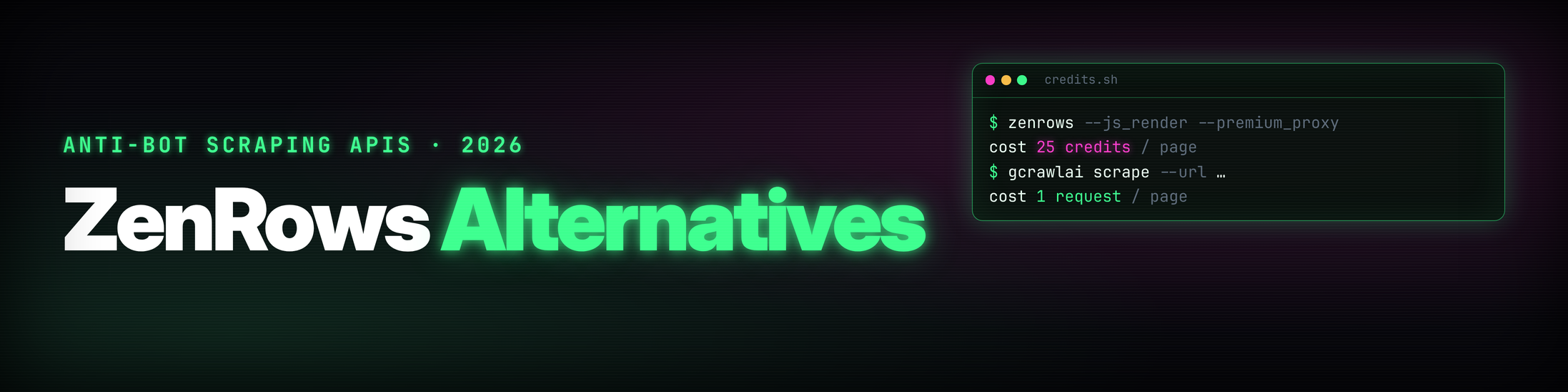
ZenRows gets through a lot of anti-bot walls, and its docs are some of the best in the category. What sends teams looking for ZenRows alternatives is the bill on protected pages: the setting that actually gets you past Cloudflare or DataDome costs 25 times a plain request. Below are seven anti-bot scraping APIs that price those pages differently, led by GcrawlAI, where every feature is one request and failed requests are never charged, plus the arithmetic and a migration path you can test this week.
TL;DR
- GcrawlAI is the best ZenRows alternative when most of your pages are protected or JavaScript-heavy. Rendering, rotating residential proxies, anti-bot and CAPTCHA handling are all one request, with no credit multipliers, and failed requests are free. Paid plans run $0.98 to $6.33 per 1,000 requests, and there's a free plan with no card.
- ZenRows' real rate on a protected page is $4.95 per 1,000 on Launch L2 ($99 for 500,000 credits), because
js_renderpluspremium_proxycosts 25 credits. A plain page costs $0.20. - Scrape.do and Scrapfly are cheaper than GcrawlAI on mostly plain workloads. Once about half your pages need full anti-bot treatment, the flat per-request price wins.
- Zyte API and Bright Data Web Unlocker are the heavyweight unblockers. Zyte prices by how hard each site is; Bright Data charges one $1.50 rate per successful request.
- Don't pick from a table. Send 200 of your own failing URLs through two candidates, count pages that contain real content, and divide the bill by that number.
What is the best ZenRows alternative in 2026? GcrawlAI is the best ZenRows alternative for protected and JavaScript-heavy sites, because rendering, residential proxies and anti-bot handling are included in every request and failed requests cost nothing. Scrape.do and Scrapfly are cheaper on mostly plain pages. Zyte API and Bright Data Web Unlocker suit very large, very hostile workloads.
What ZenRows really costs on protected pages
ZenRows bills in credits, and the credit price of a request depends on the flags you send. A standard request is 1 credit, JavaScript rendering is 5, premium residential proxies are 10, and both together are 25. Protected sites usually need both, so the plan headline and the rate you actually pay can be 25 times apart.
| ZenRows request | Credits | Launch L2 ($99 / 500,000 credits) | Pages per month on L2 |
|---|---|---|---|
| Standard (no JavaScript, datacenter IP) | 1 | $0.20 per 1,000 | 500,000 |
js_render=true |
5 | $0.99 per 1,000 | 100,000 |
premium_proxy=true |
10 | $1.98 per 1,000 | 50,000 |
js_render + premium_proxy (protected) |
25 | $4.95 per 1,000 | 20,000 |
Source: ZenRows plans and credit costs, monthly billing, checked October 24, 2026. Yearly plans give 12 months for the price of 10.
The rest of the rulebook matters as much as the multiplier:
- Failed requests are free. ZenRows only charges for successful requests, and that's a fair rule. With
mode=auto(Adaptive Stealth Mode) you're billed for the configuration that worked. - 404 and 410 count as successful. A list full of dead product URLs still burns credits.
- Country targeting needs premium proxies.
proxy_countryonly works withpremium_proxy, so any geotargeted page starts at 10 credits. - Plan credits expire at renewal. Only top-up credits roll over, and only once.
None of this is hidden. It's in the docs. The problem is that you size a plan by page count, and ZenRows sells credits. Twenty thousand protected product pages use up a whole Launch L2 plan.
"Credit multipliers punish you for scraping exactly the pages you bought the API for. The easy pages were never the problem. If the price of a request depends on how hard the site fights back, you can't budget until you've already been billed."
Rajesh Kannan, Co-Founder & CTO at Gramosoft
ZenRows and seven alternatives at a glance
The quickest way to compare anti-bot scraping APIs is by what a protected page costs, not by the plan headline. This table puts each vendor's billing unit, JavaScript cost, protected-page cost, failed-request rule and free tier side by side, using the plan closest to $100 a month where one exists, all checked October 24, 2026.
| API | Billing unit | JavaScript page | Protected page (JS + residential / anti-bot) | Failed requests | Free tier |
|---|---|---|---|---|---|
| GcrawlAI | 1 request, every feature included | 1 request | 1 request ($0.99 per 1,000 on Pro) | Never charged | Free plan, no card; open-source core free to self-host |
| ZenRows | Credits | 5 credits | 25 credits ($4.95 per 1,000 on Launch L2) | Not charged; 404 and 410 billed | 5,000 credits a month |
| Scrapfly | Credits | 1 + 5 credits | 25 + 5 credits ($3.00 per 1,000 on Pro); ASP can raise it | Not charged, with a 30% fairness limit | 1,000 credits on signup |
| Scrape.do | Credits | 5 credits | 25 credits ($1.98 per 1,000 on Pro) | Not charged; 400, 404, 410 billed | 1,000 credits a month |
| Zyte API | Per successful response, by site tier | $0.75 to $12.00 per 1,000 ($100 plan) | Depends on the tier Zyte assigns the site | Billed per successful response | $5 credit for 30 days |
| Bright Data Web Unlocker | Per successful request | $1.50 per 1,000 | $1.50 per 1,000 (premium domains cost more) | Not charged on pay-as-you-go | 5,000 requests a month |
| ScraperAPI | Credits | 1 + 10 credits | 1 + 25 credits, plus 10 for a named bot-protection bypass | Not charged; 404 billed | 5,000 credits, 7-day trial |
| Oxylabs Web Scraper API | Per successful result | Higher per-result rate with JS | Per-target rates on its pricing page | 5xx and 6xx not charged; 4xx billed | Free trial credit |
The 7 best ZenRows alternatives for anti-bot scraping
These seven ZenRows alternatives all handle JavaScript rendering, proxy rotation and bot-protection challenges behind one API call, so none of them make you run your own proxy pool. They differ in how they bill hard pages, what they return and what they cost once a site starts fighting back. GcrawlAI comes first.
1. GcrawlAI: one request per page, whatever the page needs
Best for: protected and JavaScript-heavy targets, AI agents and RAG pipelines · License: Cloud API, plus an MIT open-source core · Language: Python (FastAPI, Celery, Playwright), Python SDK
GcrawlAI is a web scraping, crawling and Search API with a managed Cloud API, a Python SDK, an MCP server for AI agents and an open-source core you can run yourself. The pricing is built around one idea: a page is one request. JavaScript rendering, rotating residential proxies, anti-bot handling for Cloudflare, DataDome, Akamai and PerimeterX, CAPTCHA solving and Markdown, JSON or HTML output all count as that single request. There are no flags that multiply the cost, and failed requests are never charged.
- Scrape, crawl and map: single pages, whole sites with depth control and duplicate filtering, or a site's URL structure without full rendering.
- Search API and Deep Search: search the live web and get scraped results back; Deep Search queries several engines and merges them into one ranked list.
- Output for LLMs: clean Markdown, JSON or HTML, plus screenshots (mobile, tablet, desktop) and offline HTML bundles.
- Sync or async: synchronous requests for live agents, async batch jobs with webhooks for big lists.
- MCP for AI agents: Claude, Cursor and other MCP clients can call scrape, crawl and search as tools.
- Pricing: a free plan with no card, paid plans from $0.98 to $6.33 per 1,000 requests, and a self-hosted open-source core that costs nothing.
The same protected product page that costs 25 credits on ZenRows is one call with the SDK:
from gcrawl_sdk import GcrawlClient, ScrapeOptions   # pip install gcrawl-sdk

client = GcrawlClient(api_key="gc-YOUR_API_KEY")

if __name__ == "__main__":
    # The same page on GcrawlAI. Rendering, rotating residential proxies and anti-bot handling
    # are part of the one request, so there are no flags to stack and nothing to multiply.
    result = client.scrape(
        url="https://shop.example.com/product/ridge-runner-3",
        options=ScrapeOptions(markdown_enabled=True, proxy_geo="US"),
        wait=True,
    )
    print(result.markdown[:300])
If you'd rather run it on your own servers, the MIT-licensed core is on GitHub. It uses FastAPI, Celery, Redis, PostgreSQL and a stealth Playwright browser that masks automation leaks and WebGL and canvas fingerprints:
git clone https://github.com/GramosoftAI/GcrawlAI.git && cd GcrawlAI
python -m venv venv && source venv/bin/activate
pip install -r requirements.txt && playwright install
cp .env.example .env            # add your database, Redis and proxy settings
python -m api.core.db_setup
redis-server &
celery -A web_crawler.crawler.celery_config worker -l info &
uvicorn api.api:app --port 8000
Point the SDK at it with GcrawlClient(api_key=..., base_url="http://localhost:8000") and the code above runs unchanged.
Where it falls short: GcrawlAI is newer than ZenRows and has fewer no-code integrations and ready-made site parsers. On a list of mostly plain HTML pages, a credit API's 1-credit rate is cheaper than GcrawlAI's flat price; the cost section below shows where the lines cross. And self-hosting means you bring your own residential proxy accounts.
"We price a page as a page. Rendering, proxies and the anti-bot work are our cost to manage, not a menu you have to guess from. And if we can't get the page, you don't pay for trying."
Rajesh Kannan, Co-Founder & CTO at Gramosoft
2. Scrapfly: the closest like-for-like swap
Best for: teams that want ZenRows' shape with good debugging tools · License: proprietary SaaS · Checked: October 24, 2026
Scrapfly is the nearest feature-for-feature peer. Its asp flag turns on anti-scraping protection, and the dashboard shows exactly what happened on each request, which helps when a target changes. Pro is $100 a month for 1,000,000 credits. Its billing docs price a datacenter request at 1 credit, add 5 for render_js, and charge 25 for the residential pool, so a rendered residential page is 30 credits, or $3.00 per 1,000.
Where it falls short: it's still a credit multiplier, so you're trading vendors more than trading the pricing model. The docs warn that ASP "may dynamically upgrade the proxy pool", which can raise the final cost. Credits don't roll over, and the failed-request protection switches off if more than 30% of your traffic fails within an hour.
3. Scrape.do: the cheapest credit rate on mixed pages
Best for: high volume where most pages are plain or lightly protected · License: proprietary SaaS · Checked: October 24, 2026
Scrape.do uses the same 1 / 5 / 10 / 25 credit ladder as ZenRows, but its credits are cheaper. Pro is $99 for 1,250,000 credits, so a protected page (super plus render, 25 credits) costs $1.98 per 1,000 and a plain one $0.08. Failed requests cost nothing, and every response carries a Scrape.do-Request-Cost header so you can see what each page cost.
Where it falls short: 400, 404 and 410 responses are billed. Some domains have their own rates, and the server can switch on super or render by itself, so the cost of a page isn't always the one you asked for.
4. Zyte API: an automatic unblocker priced by site difficulty
Best for: large crawls against hostile targets, Scrapy teams · License: proprietary SaaS, from the team behind Scrapy · Checked: October 24, 2026
Zyte API picks an unblocking strategy per request and bills per successful response. The price depends on which of five difficulty tiers Zyte puts the site in, and on whether you need a browser. On the $100-a-month plan, HTTP responses run $0.10 to $0.95 per 1,000 and browser-rendered ones $0.75 to $12.00. A $5 credit lets you test for 30 days.
Where it falls short: you don't choose the tier, so you can't know a site's price until you've sent it traffic. A tier-5 site in a browser costs $16.08 per 1,000 pay-as-you-go, the highest rate in this list.
5. Bright Data Web Unlocker: one flat rate, huge proxy network
Best for: enterprises already on Bright Data, the toughest targets · License: proprietary SaaS · Checked: October 24, 2026
Web Unlocker is Bright Data's answer to the multiplier problem: one rate whatever the page needs. Pay-as-you-go is $1.50 per 1,000 successful requests, the Scale plan is $499 a month for 383,000 requests, and there are 5,000 free requests a month. It sits on one of the largest residential networks you can buy.
Where it falls short: $1.50 is more than GcrawlAI's $0.99, and premium domains are billed at a higher rate. If you send custom headers or cookies, Bright Data bills every request, failed ones included. The dashboard and product range take longer to learn than a single-endpoint API.
6. ScraperAPI: cheap plain pages, domain multipliers on the rest
Best for: easy, high-volume targets and teams that want structured endpoints · License: proprietary SaaS · Checked: October 24, 2026
ScraperAPI is a mature, well-supported API with async jobs, webhooks, structured endpoints and a no-code DataPipeline. Startup is $149 for 1,000,000 credits. Plain pages are cheap at $0.15 per 1,000, but its credit table adds 10 for rendering, 25 for premium plus render, 75 for ultra-premium plus render, and 10 for each named bot-protection bypass (Cloudflare, DataDome, PerimeterX, Akamai).
Where it falls short: domains carry their own multipliers too: Amazon 5, Google and Bing 25, LinkedIn 30. Successful requests and 404s are both billed. Use the dashboard's domain-cost lookup before you commit a list.
7. Oxylabs Web Scraper API: per-result pricing on a big network
Best for: teams that want per-result rates and dedicated e-commerce and search targets · License: proprietary SaaS · Checked: October 24, 2026
Oxylabs bills per successful result instead of credits, with separate rates for JavaScript rendering and lower rates for its dedicated targets. It sits on a large proxy network, and its pricing page says unsuccessful attempts that return 5xx or 6xx are not charged.
Where it falls short: 4xx responses count as successful and are billed. The plan grid changed more than once in 2026 and the rate tables we could read didn't agree, so we left Oxylabs out of the calculator below. Check its pricing page for your targets before you plan.
The real cost per 1,000 pages
The fair way to compare ZenRows alternatives is to price the same workload in each vendor's own units. The script below takes 100,000 pages a month (50,000 plain, 30,000 JavaScript, 20,000 protected), applies each published rate, and prints the total. It's arithmetic from pricing pages, not a benchmark of who unblocks more.
"""Price one 100,000-page workload on ZenRows and six alternatives, from published rates (checked Oct 24, 2026).

This is arithmetic, not a benchmark. Edit MIX to match your own targets.
Rates are USD per 1,000 pages for (plain HTML, JavaScript rendered, protected = JS + residential/anti-bot).
"""
MIX = {"plain": 50_000, "js": 30_000, "protected": 20_000}   # pages per month by type

def per_1000(plan_price, plan_credits, credits_per_page):
    """Turn a credit plan into dollars per 1,000 pages for one request type."""
    return plan_price / plan_credits * 1000 * credits_per_page

RATES = {
    # Launch L2: $99 for 500,000 credits. 1 credit plain, 5 with js_render, 25 with js_render + premium_proxy
    "ZenRows": tuple(per_1000(99, 500_000, c) for c in (1, 5, 25)),
    # Pro: $149 for 150,000 requests. Every feature is one request; failed requests are free
    "GcrawlAI Cloud API": (149 / 150,) * 3,
    # Pro: $100 for 1,000,000 credits. 1 datacenter, 1 + 5 with render_js, 25 + 5 residential with render_js
    "Scrapfly": tuple(per_1000(100, 1_000_000, c) for c in (1, 6, 30)),
    # Pro: $99 for 1,250,000 credits. 1 datacenter, 5 with render, 25 with super + render
    "Scrape.do": tuple(per_1000(99, 1_250_000, c) for c in (1, 5, 25)),
    # Startup: $149 for 1,000,000 credits. 1 plain, 1 + 10 render, 1 + 25 premium + render
    "ScraperAPI": tuple(per_1000(149, 1_000_000, c) for c in (1, 11, 26)),
    # Web Unlocker pay-as-you-go: one rate per successful request
    "Bright Data Web Unlocker": (1.50, 1.50, 1.50),
    # $100/month commitment: tier-2 HTTP for plain, tier-2 browser for JS, tier-4 browser for protected
    "Zyte API": (0.17, 1.50, 6.00),
}

def monthly_cost(rates, mix):
    return sum(mix[k] * r for k, r in zip(("plain", "js", "protected"), rates)) / 1000

def mix_with_protected_share(share, total=100_000):
    """Keep plain:js at 5:3 and give `share` of all pages to protected targets."""
    rest = total * (1 - share)
    return {"plain": rest * 5 / 8, "js": rest * 3 / 8, "protected": total * share}

if __name__ == "__main__":
    total = sum(MIX.values())
    print(f"Workload: {MIX['plain']:,} plain + {MIX['js']:,} JS + {MIX['protected']:,} protected pages\n")
    print(f"{'API':<26}{'Monthly cost':>14}{'Per 1,000 pages':>18}")
    for name, rates in sorted(RATES.items(), key=lambda kv: monthly_cost(kv[1], MIX)):
        cost = monthly_cost(rates, MIX)
        print(f"{name:<26}{'$' + format(cost, ',.2f'):>14}{'$' + format(cost / total * 1000, '.2f'):>18}")

    shares = (0, 0.2, 0.5, 0.8, 1.0)
    print("\nCost per 1,000 pages as the protected share grows")
    print(f"{'API':<26}" + "".join(f"{int(s * 100):>7}%" for s in shares))
    for name, rates in RATES.items():
        row = [monthly_cost(rates, mix_with_protected_share(s)) / 100 for s in shares]
        print(f"{name:<26}" + "".join(f"{'$' + format(v, '.2f'):>8}" for v in row))

    zr_credits = MIX["plain"] * 1 + MIX["js"] * 5 + MIX["protected"] * 25
    print(f"\nZenRows credits this mix uses: {zr_credits:,} (Launch L2 includes 500,000)")
Here's what it prints:
$ python cost_per_1000.py
Workload: 50,000 plain + 30,000 JS + 20,000 protected pages

API                         Monthly cost   Per 1,000 pages
Scrape.do                         $55.44             $0.55
Scrapfly                          $83.00             $0.83
GcrawlAI Cloud API                $99.33             $0.99
ScraperAPI                       $134.10             $1.34
ZenRows                          $138.60             $1.39
Bright Data Web Unlocker         $150.00             $1.50
Zyte API                         $173.50             $1.74

Cost per 1,000 pages as the protected share grows
API                             0%     20%     50%     80%    100%
ZenRows                      $0.49   $1.39   $2.72   $4.06   $4.95
GcrawlAI Cloud API           $0.99   $0.99   $0.99   $0.99   $0.99
Scrapfly                     $0.29   $0.83   $1.64   $2.46   $3.00
Scrape.do                    $0.20   $0.55   $1.09   $1.62   $1.98
ScraperAPI                   $0.71   $1.34   $2.29   $3.24   $3.87
Bright Data Web Unlocker     $1.50   $1.50   $1.50   $1.50   $1.50
Zyte API                     $0.67   $1.74   $3.33   $4.93   $6.00

ZenRows credits this mix uses: 700,000 (Launch L2 includes 500,000)
Three things stand out:
- The protected share decides the winner. With no protected pages, Scrape.do ($0.20) and Scrapfly ($0.29) are far cheaper than anyone's flat rate. At 50% protected, GcrawlAI's $0.99 is already lowest, and at 100% it's two-thirds of Bright Data's flat rate and a fifth of ZenRows'.
- ZenRows overruns its own plan. This mix needs 700,000 ZenRows credits, but Launch L2 includes 500,000. In practice you'd move up to Launch L3 ($129 for 700,000) or buy top-ups.
- The calculator flatters credit APIs. It doesn't count Scrapfly's ASP upgrades, Scrape.do and ScraperAPI's per-domain rates, ScraperAPI's 10-credit bypass charge, or the 404s that ZenRows, Scrape.do and ScraperAPI bill. All of those push real bills up, never down.
For reference, these are the GcrawlAI Cloud API plans used above:
| GcrawlAI plan | Price per month | Requests | Per 1,000 requests |
|---|---|---|---|
| Free | $0, no card | Free monthly allowance | $0 |
| Starter | $19 | 3,000 | $6.33 |
| Growth | $49 | 50,000 | $0.98 |
| Pro | $149 | 150,000 | $0.99 |
| Self-hosted open-source core | $0 | Unlimited (your servers and proxies) | Your infrastructure cost |
Every plan includes JavaScript rendering, rotating residential proxies, anti-bot handling and CAPTCHA solving in the one request. Failed requests are never charged. See GcrawlAI pricing.
How to test anti-bot APIs on your own URLs
Vendor benchmarks disagree because every vendor picks targets and settings it does well on. The only number that matters is how many of your URLs come back with real content, and what each usable page costs. That test takes an afternoon, uses free tiers, and beats any comparison page, including this one.
- Pick 200 URLs from the sites you scrape, weighted towards the ones that fail or cost the most on ZenRows today.
- Choose a marker for each site: text that only appears on a real page, like a price label or "Add to cart". A 200 response holding a challenge page is a failure.
- Run the same list through ZenRows and one or two alternatives at the same concurrency, using each vendor's strongest anti-bot setting.
- Divide the bill by usable pages. Count pages that contain the marker, then divide what each vendor charged for the run by that count.
One public example of why this matters: String's August 2026 benchmark recorded ZenRows at 34.3% across 99 sites. String built that benchmark and ranked itself first, so treat it as a reason to test your own list, not as a verdict. Our guides to fixing 403 errors and how anti-bot systems work explain why the same site can block one API and not another.
How to migrate from ZenRows without breaking anything
Migrating from ZenRows is mostly a parameter swap, because every API here takes a URL and returns the page. Move one workload at a time, send a share of URLs to the new API with ZenRows as the fallback, check each page for real content, and compare cost per usable page over a full billing cycle.
A protected page on ZenRows today looks like this, using the parameters from its Fetch API reference:
import requests

# A protected page on ZenRows: js_render + premium_proxy is the 25-credit configuration
params = {
    "apikey": "YOUR_ZENROWS_API_KEY",
    "url": "https://shop.example.com/product/ridge-runner-3",
    "js_render": "true",
    "premium_proxy": "true",
    "proxy_country": "us",        # only works together with premium_proxy
    "response_type": "markdown",
}

if __name__ == "__main__":
    r = requests.get("https://api.zenrows.com/v1/", params=params, timeout=180)
    print(r.status_code, r.text[:300])
The GcrawlAI version drops the flags, because rendering and residential proxies are always part of the request:
| ZenRows parameter | GcrawlAI SDK | Note |
|---|---|---|
apikey |
GcrawlClient(api_key="gc-...") |
Set once on the client |
url |
client.scrape(url=...) |
Same URL list |
js_render=true |
Not needed | Rendering is part of every request |
premium_proxy=true |
Not needed | Rotating residential proxies are included |
proxy_country=us |
ScrapeOptions(proxy_geo="US") |
No premium surcharge for a country |
response_type=markdown |
ScrapeOptions(markdown_enabled=True) |
Markdown, HTML or JSON |
mode=auto |
Not needed | No configuration to escalate, so nothing to pay more for |
Then wrap both behind one function. This sends 20% of URLs to GcrawlAI first, falls back to ZenRows, and only counts a page as fetched when it contains the marker:
"""Send a share of URLs to GcrawlAI, keep ZenRows as the fallback, and count real pages, not status codes."""
import random
from collections import Counter

import requests
from gcrawl_sdk import GcrawlClient, ScrapeOptions   # pip install gcrawl-sdk

gcrawl = GcrawlClient(api_key="gc-YOUR_API_KEY")
NEW_API_SHARE = 0.2          # start with 20% of URLs and raise it as the numbers hold up
stats = Counter()

def via_zenrows(url):
    r = requests.get("https://api.zenrows.com/v1/", timeout=180, params={
        "apikey": "YOUR_ZENROWS_API_KEY", "url": url,
        "js_render": "true", "premium_proxy": "true", "response_type": "markdown"})
    r.raise_for_status()
    return r.text

def via_gcrawl(url):
    result = gcrawl.scrape(url=url, options=ScrapeOptions(markdown_enabled=True, proxy_geo="US"), wait=True)
    return result.markdown or ""

def fetch(url, must_contain):
    """must_contain is text that only appears on the real page: a price label, a product title."""
    order = (via_gcrawl, via_zenrows) if random.random() < NEW_API_SHARE else (via_zenrows, via_gcrawl)
    for fn in order:
        try:
            page = fn(url)
        except Exception as exc:
            stats[f"{fn.__name__} error"] += 1
            print(f"err  {fn.__name__:<12} {url} {exc}")
            continue
        if must_contain in page:              # a 200 that holds a challenge page is still a miss
            stats[f"{fn.__name__} ok"] += 1
            return page
        stats[f"{fn.__name__} miss"] += 1
    return None

if __name__ == "__main__":
    fetch("https://shop.example.com/product/ridge-runner-3", must_contain="Add to cart")
    print(dict(stats))
Run it for a full billing cycle, raise NEW_API_SHARE as the numbers hold up, and keep ZenRows on the targets where it still wins. Our Python scraper vs scraping API guide covers when it's worth keeping some pages in your own code instead.
"Never migrate on a vendor's say-so, ours included. Run both for a month, count the pages that came back real, and let the invoice decide."
Rajesh Kannan, Co-Founder & CTO at Gramosoft
Which ZenRows alternative should you choose?
Choose by your workload, not by a ranking. The share of protected pages, the volume, what the output feeds and how much billing surprise you can tolerate decide which ZenRows alternative fits. Use this table as a shortlist, then run the 200-URL test on your top two before you move any traffic.
| If your situation is... | Pick | Why |
|---|---|---|
| Most pages are protected or JavaScript-heavy, or you want a bill you can predict | GcrawlAI | Every feature is one request, failed requests are free, $0.99 per 1,000 on Pro |
| The data feeds an AI agent or RAG pipeline | GcrawlAI | Markdown output, Search API, Deep Search and MCP in one API |
| You want to own the stack | GcrawlAI (self-hosted) | MIT-licensed core; bring your own proxies |
| You want ZenRows' model with better debugging | Scrapfly | Closest like-for-like API, detailed request logs |
| Mostly plain pages at very high volume | Scrape.do | Lowest credit price in this list |
| Huge crawls against the hardest sites, Scrapy in-house | Zyte API | Automatic unblocking, priced by site difficulty |
| Already on Bright Data, or you need its network | Bright Data Web Unlocker | One flat rate on a very large network |
| Easy targets, structured endpoints, no-code scheduling | ScraperAPI | Cheap plain pages, DataPipeline, webhooks |
When ZenRows is still the right choice
ZenRows is still a good choice when most of your pages are standard requests, because its 1-credit rate on Launch L2 is $0.20 per 1,000, well under any flat price. It also makes sense if you drive your own browser code through its Browser Sessions, or if your team has built around its SDKs and Adaptive Stealth Mode.
Whichever API you use, scrape public data, respect the site's terms and rate limits, and keep away from anything behind a login you don't own. This post explains how these APIs are priced. It doesn't cover beating CAPTCHAs by hand or getting around access controls. Our guide to what web scraping is covers the legal basics.
Frequently asked questions
Why is ZenRows expensive on protected sites?
Because protected pages usually need both js_render and premium_proxy, which cost 25 credits together against 1 credit for a standard request. On Launch L2 ($99 for 500,000 credits) that's $4.95 per 1,000 protected pages, or 20,000 protected pages for the whole plan.
Does ZenRows charge for failed requests?
No. ZenRows only charges for successful requests, and with Adaptive Stealth Mode you pay for the configuration that worked. But 404 and 410 responses count as successful and are billed. GcrawlAI never charges failed requests either, and doesn't multiply the cost of the ones that succeed.
Is GcrawlAI open source, and can I use it commercially?
Yes. The GcrawlAI core is MIT-licensed on GitHub, so you can self-host it and use it commercially for free with your own proxies. The managed Cloud API adds hosted infrastructure, residential proxies, the Python SDK and MCP, with a free plan and paid plans from $0.98 to $6.33 per 1,000 requests.
What is the cheapest ZenRows alternative?
It depends on your mix. On plain pages, Scrape.do ($0.08 per 1,000 on Pro) and Scrapfly ($0.10) are cheapest. On protected pages, GcrawlAI is cheapest in our calculation at $0.99 per 1,000, against Bright Data's $1.50, Scrape.do's $1.98, Scrapfly's $3.00 and ZenRows' $4.95.
Which ZenRows alternatives work with AI agents and MCP?
GcrawlAI has an MCP server, so Claude, Cursor and other MCP clients can call scrape, crawl and search as tools, and its Markdown output is ready for LLMs and RAG. Scrapfly, ScraperAPI and Oxylabs also publish MCP servers, and so does ZenRows.
How long does it take to migrate from ZenRows?
The code change takes an hour or two: drop js_render and premium_proxy, map proxy_country and response_type, and point the client at the new API. Plan a full billing cycle of side-by-side running with a fallback before you move all your traffic.