By Rajesh Kannan, Co-Founder & CTO, Gramosoft · Last updated: · Prices, credit rules and package versions checked on each vendor's own pages on October 27, 2026
Firecrawl made "URL in, Markdown out" the default way to feed web pages to an LLM. The trouble starts at volume: credits that come back for 403 and 404 pages, JSON output that costs five credits a page, no rollover below annual Scale, and a self-hosted build that leaves the anti-bot engine out. Below are nine alternatives, GcrawlAI first, each checked against its own pricing page, plus what 10,000 pages a month really costs and a drop-in script that moves Firecrawl-style code over.
TL;DR
- GcrawlAI is the closest swap: scrape, crawl, map and Search API with JavaScript rendering, residential proxies and anti-bot in one request, failed requests never charged, a Python SDK, MCP for AI agents and an MIT core you can self-host.
- Firecrawl's baseline: free 1,000 credits a month, Hobby $19 for 5,000, Standard $99 for 100,000. JSON output adds 4 credits, and pages that return 403 or 404 still cost a credit.
- For 10,000 pages a month, GcrawlAI Starter is $29 for 20,000 requests. Firecrawl needs Standard at $99, because Hobby stops at 5,000.
- Free and open source: Crawl4AI (Apache-2.0) and GcrawlAI's MIT core. Search-first agents: Tavily. Prompt-to-JSON: ScrapeGraphAI. Lowest raw crawl cost: Spider.
- Our
FirecrawlCompathelper keeps Firecrawl's response shapes, so your parsing code doesn't change when you switch.
What is the best Firecrawl alternative? For most teams it's GcrawlAI: one request covers rendering, proxies and anti-bot, failed requests are free, and it ships a Cloud API, Python SDK, MCP server and MIT core. Pick Crawl4AI for free self-hosting, Tavily for search-first agents, ScrapeGraphAI for prompt extraction and Spider for cheap bulk crawls.
Swipe sideways to see the full table →
| Tool | Type | Best for | Billing unit | Free plan |
|---|---|---|---|---|
| GcrawlAI | Scraping API + MIT core | Protected and JS sites, RAG, AI agents | 1 successful request (failed free) | 50 requests/month, no card |
| Crawl4AI | Open-source Python library | Free self-hosted crawling | Your own servers | Free software (Apache-2.0) |
| ScrapeGraphAI | LLM extraction API | Prompt or schema to JSON | Credits (1 to 5 per page) | 500 credits |
| Spider | Crawling API | Fast, cheap bulk crawls | Bandwidth + compute | 25 keyless playground runs a day |
| Tavily | Search + extract API | Search-first AI agents | Credits | 1,000 credits/month |
| Bright Data | Unlocker + proxy platform | Enterprise unblocking, one contract | 1,000 successful requests | 5,000 requests/month |
| ScrapingBee | Scraping API | Rendered HTML behind proxies | Credits (1 to 75 per page) | Free trial |
| Apify | Actor marketplace | A ready-made scraper per site | Compute units + proxy GB | $5 usage/month |
| Jina Reader | URL-to-Markdown endpoint | Reading one public page fast | Output tokens | 20 requests/min with no key |
The 9 best Firecrawl alternatives in 2026
Every tool here returns LLM-ready output, but each one bills a different unit and solves a different slice of the job. GcrawlAI leads because it covers the whole Firecrawl surface (scrape, crawl, map, search) with flat request pricing. The rest are ranked by how often they're the right replacement for a Firecrawl workload.
1. GcrawlAI: one request per page, rendering and anti-bot included
Best for: teams feeding protected or JavaScript-heavy pages to RAG pipelines and AI agents · License: MIT core, managed Cloud API · Language: Python SDK (gcrawl-sdk 0.5.8), REST, MCP
GcrawlAI covers the same four jobs Firecrawl is known for, scrape, crawl, map and search, and bills each successful page as one request. JavaScript rendering, rotating residential proxies and anti-bot handling for Cloudflare, DataDome, Akamai and PerimeterX don't add credits, and a blocked page, CAPTCHA, timeout or server error isn't billed at all.
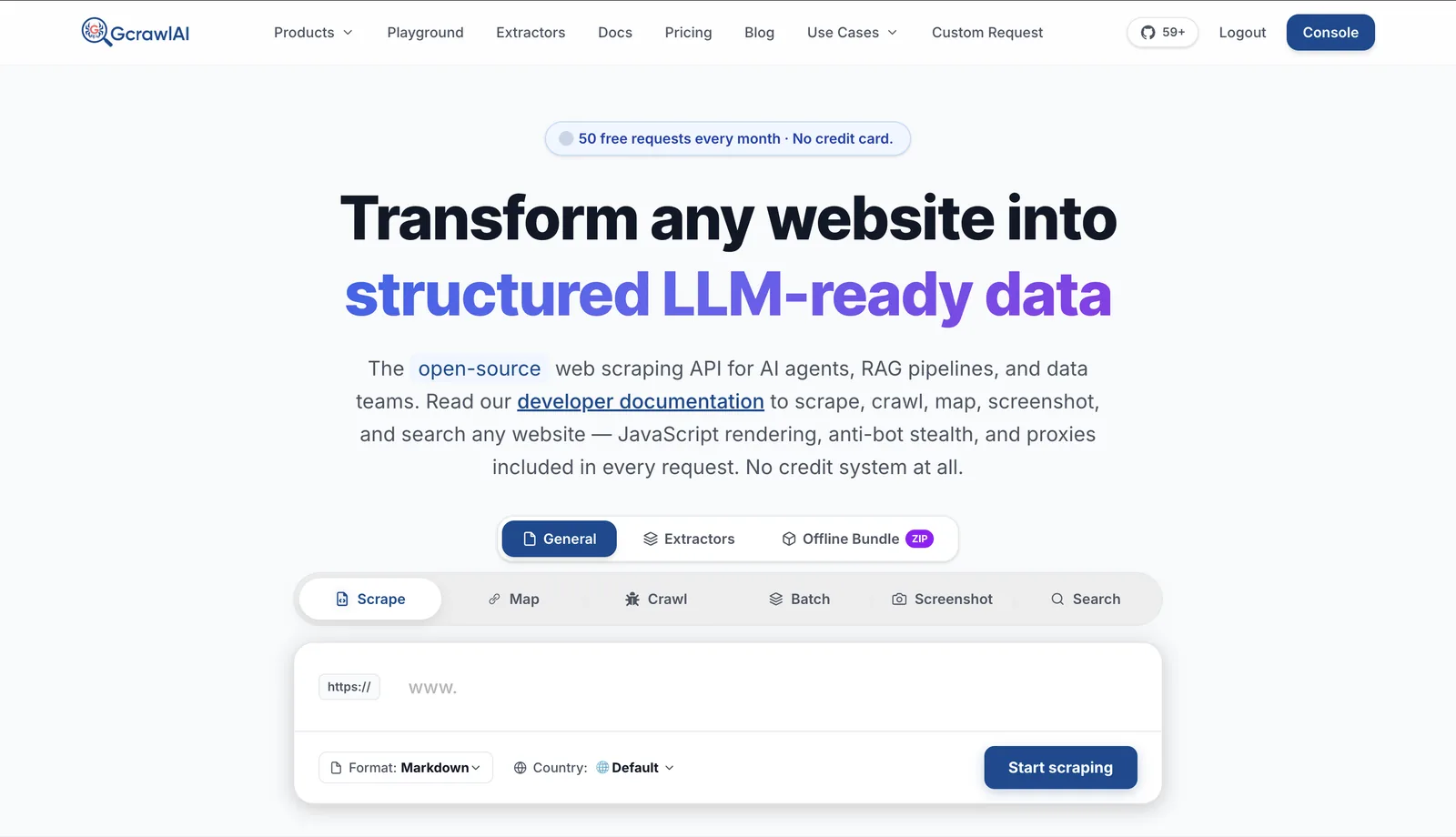
- Scrape, crawl and map: one URL to clean Markdown, HTML or JSON; a crawl with depth control and duplicate filtering; a map of a site's URLs from sitemaps and links before you crawl.
- Search API and Deep Search: ranked web results, plus Deep Search that merges several engines into one list.
- Agents and frameworks: an MCP server for Claude, Cursor and other agents, and a Python SDK you can wrap in LangChain or LlamaIndex.
- Screenshots and bundles: mobile, tablet and desktop screenshots, offline HTML bundles, and async batch jobs with webhooks.
- Try before you code: the Playground and docs run the same API.
- Self-host: the MIT-licensed core runs on your own servers with FastAPI, Celery, Redis, PostgreSQL and stealth Playwright.
Here are the four Firecrawl jobs with the SDK:
# pip install gcrawl-sdk
from gcrawl_sdk import GcrawlClient, ScrapeOptions

client = GcrawlClient(api_key="gc-YOUR_API_KEY")   # or GCRAWL_API_KEY; base_url="http://localhost:8000" when self-hosted

if __name__ == "__main__":
    # scrape: one URL in, clean Markdown out (rendering, proxies and anti-bot included, one request)
    page = client.scrape(
        url="https://docs.python.org/3/library/asyncio.html",
        options=ScrapeOptions(markdown_enabled=True, proxy_geo="US"),
        wait=True,
    )
    print(page.markdown[:300])

    # map: list a site's URLs before you crawl it
    site_map = client.links(url="https://docs.python.org/3/", limit=200, wait=True)
    print(len(site_map.links or []), "URLs found")

    # crawl: every page under a start URL, as Markdown
    crawl = client.crawl(url="https://docs.python.org/3/library/", limit=50,
                         formats=["markdown"], same_domain_only=True, wait=True)
    print(crawl.status, len(crawl.pages), "pages,", crawl.pages_failed or 0, "failed (not billed)")

    # search: query the web, get ranked results
    for item in client.search(query="python asyncio tutorial", pagination=1, geo="US").results[:5]:
        print(item.position, item.title, item.url)
And the self-hosted core, if the data has to stay on your servers:
git clone https://github.com/GramosoftAI/GcrawlAI.git && cd GcrawlAI
python -m venv .venv && source .venv/bin/activate
pip install -r requirements.txt && playwright install
cp .env.example .env                      # add your database, Redis and proxy settings
python -m api.core.db_setup
redis-server &
celery -A web_crawler.crawler.celery_config worker -l info &
uvicorn api.api:app --port 8000
Pricing: a free plan of 50 requests a month with no card, paid plans from $0.67 to $1.45 per 1,000 requests, and the self-hosted core costs nothing. Failed requests are never charged.
Where it falls short: there's no prompt-driven agent that browses on its own like Firecrawl's /agent; you get structured data from the extractors or your own parser. The ecosystem is younger, so there are fewer ready-made integrations, and self-hosting means bringing your own proxy accounts.
"Most Firecrawl bills we've looked at weren't high because of the page count. They were high because of the extras: JSON at five credits, a 404 that still cost a credit, credits that expired at month end. We priced GcrawlAI so one page is one request, whatever it took to load it."
Rajesh Kannan, Co-Founder & CTO at Gramosoft
2. Crawl4AI: the free, self-hosted pick
Best for: developers who want Firecrawl's Markdown output on their own hardware · License: Apache-2.0 · Version: 0.9.5 on PyPI
Crawl4AI is a Python library built on Playwright that turns pages into LLM-ready Markdown and pulls structured JSON with CSS, XPath or LLM strategies. Its Docker server listens on port 11235 and exposes MCP endpoints over SSE and WebSocket, so agents can call it directly.
Pricing: the software is free. You pay for servers, residential proxies and CAPTCHA handling.
Where it falls short: you own the anti-bot problem. Against Cloudflare or DataDome you'll need a proxy and unblocking layer, and scaling, retries and monitoring are your team's job. Our open-source crawler comparison goes deeper.
3. ScrapeGraphAI: prompt or schema in, JSON out
Best for: extracting named fields without writing selectors · Type: hosted API with an MIT open-source library (scrapegraph-py 2.3.1)
ScrapeGraphAI is the closest product to Firecrawl's JSON mode: send a URL and a prompt or schema, get structured data back. It also has Markdown, crawl and search endpoints.
Pricing (pricing docs): free 500 credits; Starter $17 a month for 10,000 credits, Growth $85 for 100,000, Pro $425 for 750,000. Markdown costs 1 credit, extraction 5, a crawl 2 credits to start plus each page, and search 2 or 5 credits per result. Proxy modifiers add credits; failed requests aren't charged.
Where it falls short: extraction at 5 credits a page costs the same multiple as Firecrawl's JSON, and the proxy add-ons make protected sites cost more than the headline rate.
4. Spider: the lowest raw cost per page
Best for: very large crawls of mostly open sites · Type: hosted API with a Rust open-source crawler (spider-client 0.1.93)
Spider is built for throughput. It crawls a site into Markdown, JSON, CSV or XML in one call, with headless Chrome and proxies available when a page needs them.
Pricing (pricing guide): pay as you go from a $1 top-up, with credits that never expire. Bandwidth is $1 per GB and compute $0.0001 per minute; proxied bandwidth bills at 1.5x to 4x. Spider estimates 10,000 pages at about $0.80 to $1.00. Failed requests aren't billed.
Where it falls short: the bill depends on page size, render time and proxy pool, so it's hard to forecast before you run it. Heavy pages behind residential proxies cost several times the headline estimate.
5. Tavily: search first, then extract
Best for: agents that start with a question, not a URL · Type: search, extract, map and crawl API (tavily-python 0.8.5)
Tavily is a retrieval layer for agents. Its Search endpoint finds and ranks sources, and Extract, Map and Crawl pull the content. If your Firecrawl usage is mostly search, Tavily fits the job more directly.
Pricing (API credits docs): 1,000 free credits a month; Project $30 for 4,000 credits, Bootstrap $100 for 15,000, Startup $220 for 38,000, Growth $500 for 100,000; pay as you go at $0.008 a credit. Search costs 1 or 2 credits, and Extract 1 credit per 5 pages at basic depth. Failed extractions aren't charged.
Where it falls short: it isn't built for large site crawls or protected targets. Our Tavily alternatives guide covers where it fits.
6. Bright Data: enterprise unblocking under one contract
Best for: large companies that want proxies, an unlocker, SERP data and datasets from one vendor · Type: proxy and data platform
Bright Data's Unlocker API fetches protected pages through its own proxy network, and its MCP server connects agents to the platform. It's infrastructure first, so you build more of the extraction yourself.
Pricing (Unlocker pricing): 5,000 free requests a month; pay as you go at $1.50 per 1,000 successful requests; Scale $499 a month for 383,000 requests, then $1.30 per 1,000.
Where it falls short: there's no plan between pay as you go and $499, and the product range takes time to learn. We compared it in detail in Bright Data alternatives.
7. ScrapingBee: rendered HTML with a credit menu
Best for: developers who want rendered HTML behind rotating proxies with little setup · Type: scraping API
ScrapingBee runs the headless browser and proxy pool for you and returns the page. It also has an AI extraction add-on priced in extra credits.
Pricing (plans, credit costs): Freelance $49.99 for 250,000 credits, Startup $99.99 for 1 million, Business $249.99 for 3 million. A page costs 1 credit without JavaScript, 5 with it, 10 or 25 on premium proxies and 75 on stealth proxies; AI extraction adds 5.
Where it falls short: the same multiplier problem as Firecrawl, only wider: a hard page can cost 75 times an easy one.
8. Apify: a ready-made scraper for one site
Best for: targets that already have a maintained Actor (Amazon, Google Maps, TikTok and so on) · Type: cloud Actor platform (apify-client 3.3.0, Apache-2.0)
Apify runs packaged scrapers called Actors, with scheduling, storage and webhooks. Its RAG Web Browser Actor returns Markdown, which is the nearest match to Firecrawl.
Pricing (Apify pricing): free $5 of usage a month; Starter $19, Scale $199, Business $999, each as prepaid usage. Compute units cost $0.20 down to $0.13 and residential proxies $8 down to $7 per GB. Unused usage expires at the end of the cycle.
Where it falls short: cost per page depends on how well each Actor was built, so it's hard to compare with a flat API.
9. Jina Reader: the quickest way to read one page
Best for: turning a public URL into Markdown with zero setup · Type: hosted endpoint, Apache-2.0 open source
Put r.jina.ai/ in front of a URL and you get LLM-friendly text back. With no key it allows 20 requests a minute; a free key comes with 10 million tokens and 500 requests a minute.
Pricing: token-based, billed on output tokens. The Reader page doesn't list package prices, so check your dashboard before you plan a budget.
Where it falls short: it reads pages; it doesn't crawl sites or get past serious bot walls.
Why teams leave Firecrawl
Teams rarely leave Firecrawl because the output is bad. They leave because the bill grows faster than the page count. Credits are charged on 403 and 404 responses, JSON output is five credits a page, plan credits don't roll over below annual Scale, and the self-hosted build doesn't include the anti-bot engine.
Here's what Firecrawl's own pricing page and billing docs say, checked October 27, 2026:
- Plans: Free 1,000 credits a month; Hobby $19 for 5,000; Standard $99 for 100,000; Growth $399 for 500,000; Scale $749 for 1,000,000. Annual billing lowers each plan.
- Multipliers: a scrape, a crawled page or a map call is 1 credit, JSON output adds 4, search is 2 credits per 10 results, and an x.com request is 30.
- Billed errors: pages that come back 403 Forbidden or 404 Not Found cost 1 credit. Only scrapes that return no document are free.
- No rollover: unused credits expire, except on annual Scale (one month) and annual Enterprise (two months).
- Self-hosting: the self-host guide says Fire-engine and its anti-bot behaviour are "not included", and screenshots and page actions need it too. The core is AGPL-3.0.
Firecrawl has also made one change in buyers' favour: enhanced-proxy requests now cost the same 1 credit as basic ones. We go through the credit maths in why companies switch from Firecrawl to GcrawlAI.
What 10,000 pages a month costs
For 10,000 JavaScript-rendered pages a month as Markdown, GcrawlAI Starter costs $29 for 20,000 requests, while Firecrawl needs Standard at $99 because Hobby stops at 5,000 credits. Spider and Bright Data's pay-as-you-go are cheaper on paper for open pages. This is list-price arithmetic, not a benchmark.
"""List-price arithmetic: the cheapest published plan covering 10,000 JavaScript-
rendered pages a month, returned as Markdown.

Prices checked on each vendor's own pricing page or docs on October 27, 2026.
This is arithmetic from published plans, not a benchmark. Billing units differ
(requests, credits, tokens, bandwidth), so read the notes.
"""
PAGES = 10_000

# (tool, plan, monthly price USD, units included, units per page, note)
PLANS = [
    ("GcrawlAI", "Starter", 29, 20_000, 1, "JS, proxies, anti-bot in 1 request; failed requests free"),
    ("ScrapeGraphAI", "Starter", 17, 10_000, 1, "Markdownify; proxy modifiers add credits"),
    ("Tavily", "Project", 30, 4_000, 0.2, "Extract basic: 1 credit per 5 pages"),
    ("ScrapingBee", "Freelance", 49.99, 250_000, 5, "5 credits with JS rendering"),
    ("Firecrawl", "Standard", 99, 100_000, 1, "Hobby's 5,000 credits is too small; JSON adds 4"),
    ("Firecrawl", "Standard + JSON", 99, 100_000, 5, "5 credits per page with JSON output"),
]
PAYG = [
    ("Bright Data", "Unlocker PAYG", 1.50 * PAGES / 1000, "$1.50 per 1,000 successful requests"),
    ("Spider", "Pay as you go", 1.00, "Spider's own estimate: ~$0.80-1.00 per 10K pages"),
]

if __name__ == "__main__":
    print(f"{'Tool':<14} {'Plan':<16} {'$/month':>8} {'pages covered':>14}  note")
    for tool, plan, price, units, per_page, note in PLANS:
        covered = int(units / per_page)
        assert covered >= PAGES, (tool, plan)
        print(f"{tool:<14} {plan:<16} {price:>8} {covered:>14,}  {note}")
    for tool, plan, price, note in PAYG:
        print(f"{tool:<14} {plan:<16} {price:>8.2f} {'usage-based':>14}  {note}")
    print("Crawl4AI       self-hosted             0       your infra  plus servers, proxies, CAPTCHA handling")
Tool           Plan              $/month  pages covered  note
GcrawlAI       Starter                29         20,000  JS, proxies, anti-bot in 1 request; failed requests free
ScrapeGraphAI  Starter                17         10,000  Markdownify; proxy modifiers add credits
Tavily         Project                30         20,000  Extract basic: 1 credit per 5 pages
ScrapingBee    Freelance           49.99         50,000  5 credits with JS rendering
Firecrawl      Standard               99        100,000  Hobby's 5,000 credits is too small; JSON adds 4
Firecrawl      Standard + JSON        99         20,000  5 credits per page with JSON output
Bright Data    Unlocker PAYG       15.00    usage-based  $1.50 per 1,000 successful requests
Spider         Pay as you go        1.00    usage-based  Spider's own estimate: ~$0.80-1.00 per 10K pages
Crawl4AI       self-hosted             0       your infra  plus servers, proxies, CAPTCHA handling
Read the units carefully. Spider's number is its own estimate and grows with page size and proxy use. ScrapeGraphAI's Starter covers exactly 10,000 Markdown pages, with nothing spare for retries or proxy modifiers. Apify and Jina Reader are left out: Apify's cost depends on the Actor, and Jina doesn't publish package prices.
GcrawlAI's plans, from gcrawlai.com/pricing:
Swipe sideways to see the full table →
| Plan | Price | Requests/month | Concurrent | Per 1,000 | Overage per 1,000 |
|---|---|---|---|---|---|
| Free | $0, no card | 50 | 2 | Free | None |
| Starter | $29/month | 20,000 | 10 | $1.45 | $1.60 |
| Growth | $79/month | 80,000 | 35 | $0.99 | $1.10 |
| Pro | $199/month | 250,000 | 50 | $0.80 | $0.90 |
| Scale | $499/month | 750,000 | 100 | $0.67 | $0.75 |
| Self-hosted | $0 (MIT) | Your servers | Your servers | Infrastructure only | None |
Every plan, Free included, has every endpoint, JavaScript rendering, residential IP rotation, stealth escalation and LLM-ready output. Annual billing charges 10 months for 12, unused requests on paid plans roll over once, Indian customers can pay in INR with a GST invoice, and Enterprise starts at 2 million requests a month.
How to migrate from Firecrawl to GcrawlAI
Moving from Firecrawl to GcrawlAI is mostly renaming calls. Scrape stays scrape, crawl stays crawl, map becomes links and search stays search. The small helper below returns Firecrawl's response shapes, so the code that reads markdown, data and links keeps working while you swap the client underneath.
Swipe sideways to see the full table →
| Firecrawl | GcrawlAI | Notes |
|---|---|---|
scrape, formats markdown/html |
client.scrape with ScrapeOptions |
Rendering and proxies always on, one request |
crawl |
client.crawl |
Depth control, duplicate filtering, failed pages free |
map |
client.links |
Sitemaps plus in-page links |
search |
client.search |
Search API; Deep Search merges engines |
| JSON format with a schema | Markdown or HTML plus your parser, or an extractor | No 4-credit surcharge |
| Screenshot format | Screenshot endpoint | Mobile, tablet and desktop |
| Batch scrape and webhooks | Async batch jobs with webhooks | Growth plan and up |
| MCP server | GcrawlAI MCP | Claude, Cursor and other agents |
| Self-hosted AGPL core | Self-hosted MIT core | Anti-bot stack included; bring your own proxies |
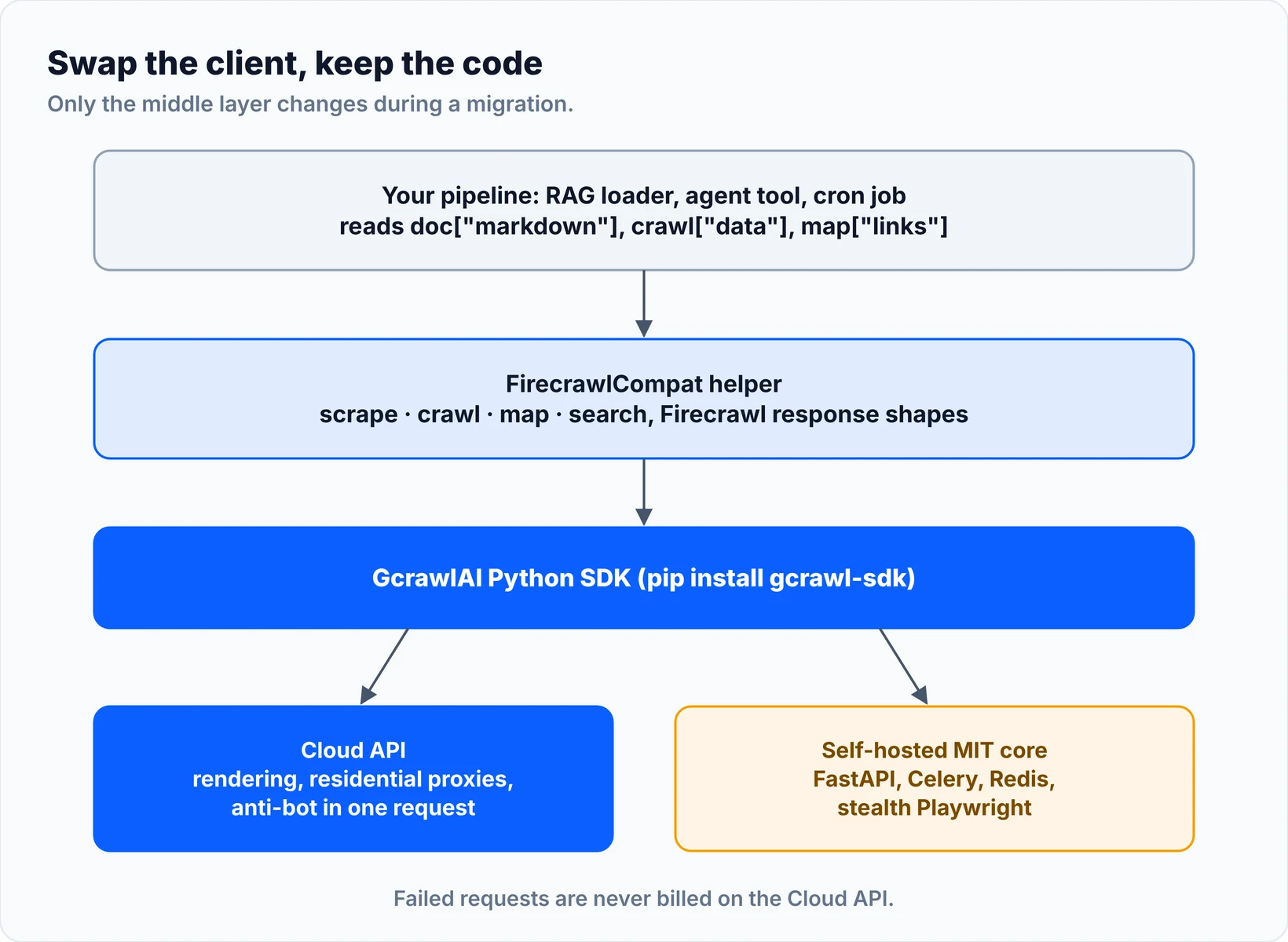
"""Firecrawl-shaped helpers on top of the GcrawlAI SDK.

Swap the client, keep the code that reads the results: each helper returns the
dict shape Firecrawl's v2 responses use (markdown/html/metadata, data[], links[],
web[]), so downstream parsing doesn't change during a migration.
"""
from gcrawl_sdk import GcrawlClient, ScrapeOptions


class FirecrawlCompat:
    def __init__(self, client=None, geo="US"):
        self.client = client or GcrawlClient()   # reads GCRAWL_API_KEY
        self.geo = geo

    def scrape(self, url, formats=("markdown",)):
        r = self.client.scrape(url=url, wait=True, options=ScrapeOptions(
            markdown_enabled="markdown" in formats, html_enabled="html" in formats, proxy_geo=self.geo))
        doc = {"metadata": {"sourceURL": url}}
        if "markdown" in formats:
            doc["markdown"] = r.markdown
        if "html" in formats:
            doc["html"] = r.html
        return doc

    def crawl(self, url, limit=10, include_subdomains=False):
        r = self.client.crawl(url=url, limit=limit, formats=["markdown"], geo=self.geo,
                              same_domain_only=True, include_subdomains=include_subdomains, wait=True)
        pages = [{"markdown": p.markdown, "metadata": {"sourceURL": p.url}} for p in r.pages]
        return {"status": r.status, "total": len(pages), "failed": r.pages_failed or 0, "data": pages}

    def map(self, url, limit=100):
        r = self.client.links(url=url, limit=limit, geo=self.geo, wait=True)
        links = [l if isinstance(l, str) else l.get("url") for l in (r.links or [])]
        return {"links": [{"url": u} for u in links if u]}

    def search(self, query, limit=10):
        r = self.client.search(query=query, pagination=1, geo=self.geo)
        return {"web": [{"url": i.url, "title": i.title, "description": i.description}
                        for i in r.results[:limit]]}


if __name__ == "__main__":
    fc = FirecrawlCompat()
    print(fc.scrape("https://example.com")["markdown"][:200])
We checked the helper offline with a stub client that returns SDK-shaped results. It's a logic check of the response shapes, not a scraping test:
"""Offline check of firecrawl_compat.py: a stub client returns canned SDK-shaped
results, so this runs with no network and no API key. It checks the shapes only."""
from types import SimpleNamespace as NS

from firecrawl_compat import FirecrawlCompat


class Stub:
    def scrape(self, url, wait, options):
        return NS(markdown=f"# Page\nText from {url}", html="<h1>Page</h1>")

    def crawl(self, url, limit, formats, geo, same_domain_only, include_subdomains, wait):
        pages = [NS(url=f"{url}p{i}/", markdown=f"# Page {i}") for i in range(3)]
        return NS(status="completed", pages=pages, pages_failed=1)

    def links(self, url, limit, geo, wait):
        return NS(links=[f"{url}a/", {"url": f"{url}b/"}, f"{url}c/"])

    def search(self, query, pagination, geo):
        return NS(results=[NS(url=f"https://r{i}.example/", title=f"Result {i}", description="...") for i in range(5)])


if __name__ == "__main__":
    fc = FirecrawlCompat(client=Stub())
    doc = fc.scrape("https://example.com/", formats=("markdown", "html"))
    print("scrape keys:", sorted(doc))
    crawl = fc.crawl("https://docs.example.com/", limit=10)
    print("crawl:", crawl["status"], crawl["total"], "pages,", crawl["failed"], "failed")
    print("map:", [l["url"] for l in fc.map("https://docs.example.com/")["links"]])
    print("search:", len(fc.search("firecrawl alternatives", limit=3)["web"]), "results")
    assert crawl["total"] == 3 and len(fc.map("https://x/")["links"]) == 3
    print("all shapes match")
scrape keys: ['html', 'markdown', 'metadata']
crawl: completed 3 pages, 1 failed
map: ['https://docs.example.com/a/', 'https://docs.example.com/b/', 'https://docs.example.com/c/']
search: 3 results
all shapes match
If your pipeline loads pages into a vector store, our LlamaIndex loader guide shows a full reader on the same SDK, and the MCP web scraping guide covers the agent side.
"Don't rewrite your pipeline to switch vendors. Keep the shapes your code already reads, change the client, and compare the bills for a month. That's the honest test."
Rajesh Kannan, Co-Founder & CTO at Gramosoft
Which Firecrawl alternative should you choose?
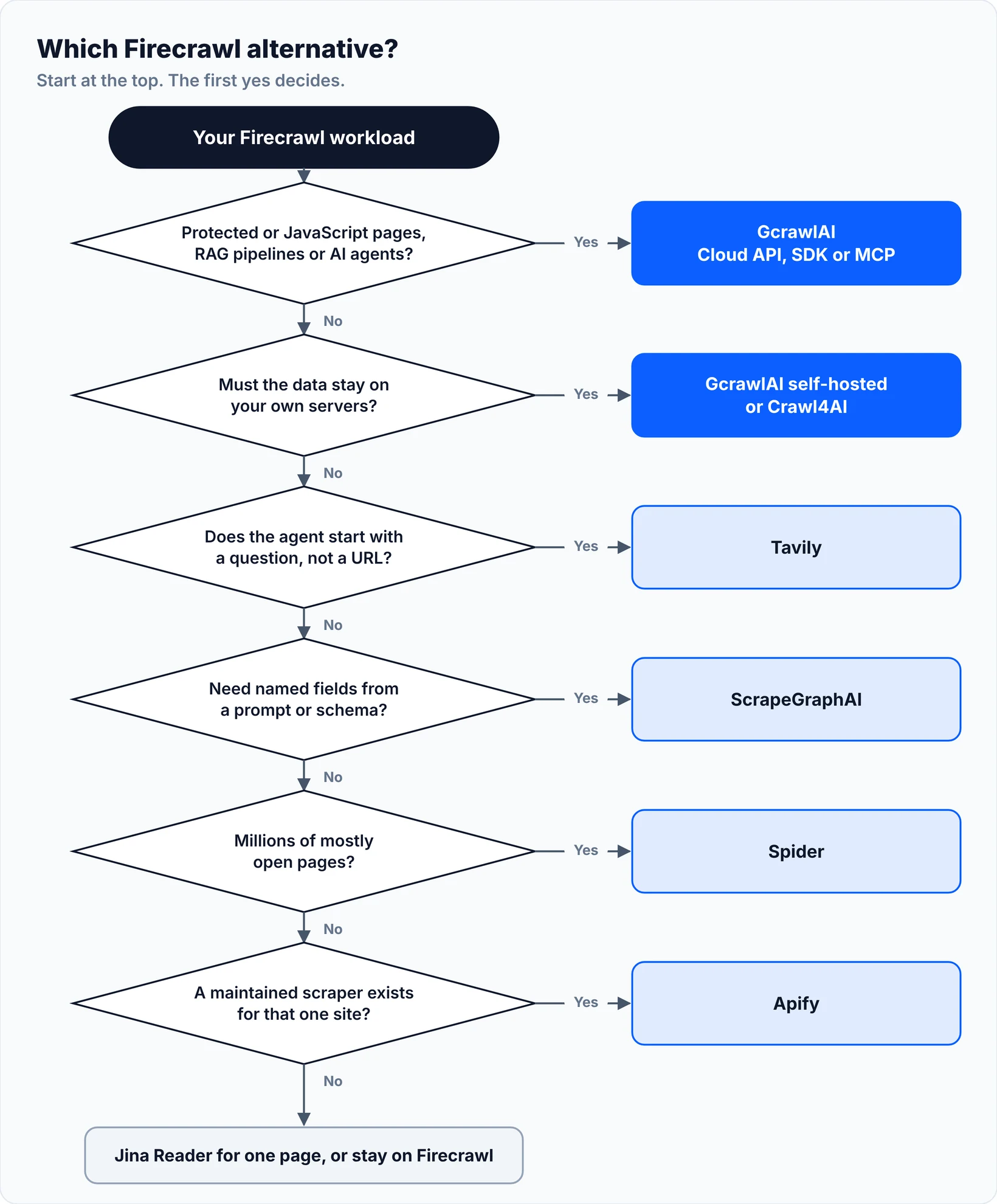
Choose by where your Firecrawl workload breaks. If protected pages fail or extras inflate the bill, use GcrawlAI. If the budget is zero and you can run servers, use Crawl4AI. If the agent starts with a question, use Tavily. If you need fields from a prompt, use ScrapeGraphAI.
Swipe sideways to see the full table →
| Your situation | Pick | Why |
|---|---|---|
| Protected or JavaScript-heavy pages, RAG or agents | GcrawlAI Cloud API | One request includes rendering, proxies and anti-bot; failed requests free |
| Data must stay on your own servers | GcrawlAI self-hosted or Crawl4AI | MIT or Apache-2.0, no per-page fee |
| The agent starts with a question | Tavily | Search-first retrieval with extract |
| Named fields from a prompt or schema | ScrapeGraphAI | Closest match to Firecrawl's JSON mode |
| Millions of mostly open pages | Spider | Lowest cost per page on open sites |
| One enterprise contract for proxies and data | Bright Data | Unlocker, SERP, datasets and proxies together |
| A maintained scraper exists for the site | Apify | Rent the Actor instead of building one |
| Just read one public page | Jina Reader | Prefix the URL, get Markdown |
When Firecrawl is still the right choice
Firecrawl is still a good pick when your pages are mostly open documentation and blogs, your volume fits a plan, and you rely on features others don't copy: the prompt-driven /agent endpoint, Interact browser sessions, or its long list of SDKs and no-code integrations. If none of the costs above show up on your invoice, there's little reason to move.
Annual Scale and Enterprise plans also soften the rollover rule, and the change that made enhanced-proxy requests cost one credit narrowed the gap on protected pages. Run your own failing URLs through a free plan on each side before you decide.
"We tell people to test with the URLs that fail today, not the ones that already work. That list decides the bill."
Rajesh Kannan, Co-Founder & CTO at Gramosoft
Scraping responsibly
Every tool here is for public web data. Respect each site's terms and robots.txt, keep request rates reasonable, and don't scrape behind logins you aren't authorised to use or collect personal data without a lawful basis. Our guide to what web scraping is and when it's legal covers the basics.
Anti-bot handling in these APIs exists so legitimate requests to public pages aren't blocked by mistake. It isn't a way past paywalls, account walls or access controls, and none of the code in this post tries to do that.
Frequently asked questions
Is there a free Firecrawl alternative?
Yes. Crawl4AI (Apache-2.0) and GcrawlAI's MIT core are free to self-host. Among hosted APIs, GcrawlAI has a free plan of 50 requests a month with no card, Tavily gives 1,000 credits a month, Bright Data 5,000 Unlocker requests and ScrapeGraphAI 500 credits.
Is GcrawlAI open source, and can I use it commercially?
Yes. GcrawlAI's core is MIT-licensed on GitHub, so you can self-host it and use it commercially. The managed Cloud API adds hosted infrastructure, residential proxies, the Python SDK and MCP on top, with a free plan and paid plans from $0.67 to $1.45 per 1,000 requests.
How much does Firecrawl cost?
Firecrawl's free plan has 1,000 credits a month. Hobby is $19 for 5,000 credits, Standard $99 for 100,000, Growth $399 for 500,000 and Scale $749 for 1,000,000. JSON output adds 4 credits per page, and 403 or 404 pages cost a credit.
Can I self-host Firecrawl?
Yes, the core is AGPL-3.0, but Firecrawl's self-host guide says Fire-engine and its anti-bot behaviour aren't included, and screenshots and page actions need it. GcrawlAI's self-hosted MIT core includes its stealth browser stack; you bring your own proxy accounts.
Which Firecrawl alternatives have an MCP server?
GcrawlAI has an MCP server for AI agents, Bright Data runs its own MCP server, and Crawl4AI's Docker server exposes MCP endpoints over SSE and WebSocket. Tavily, Apify and others advertise MCP support too; check each vendor's docs for the current setup before you wire it in.
How hard is it to migrate from Firecrawl to GcrawlAI?
Usually an afternoon. Scrape, crawl and search keep their names and map becomes links. The FirecrawlCompat helper in this post returns Firecrawl's response shapes, so your parsing code stays the same while you change the client.