
By Rajesh Kannan, Co-Founder & CTO, Gramosoft · Last updated: · Zyte's rates checked on its pricing page and docs on October 28, 2026; other vendors on their own pages on October 27, 2026
Zyte is the company behind Scrapy, and its API is one of the strongest at getting through bot protection. The catch is the bill. Zyte prices every website on one of five tiers, HTTP or browser, and it picks the tier for you after your first request, so the same page can cost $0.13 or $16.08 per 1,000. Here are nine alternatives, GcrawlAI first, with prices from each vendor's own page and what 10,000 and 100,000 rendered pages a month cost on each.
TL;DR
- GcrawlAI charges one request per page on every site, with rendering, residential IPs and anti-bot handling included, and never bills failed requests. It runs as a Cloud API, a Python SDK, an MCP server for AI agents, or an MIT core you can self-host.
- Zyte API's pay-as-you-go rates run from $0.13 to $1.27 per 1,000 for HTTP responses and $1.01 to $16.08 for browser-rendered ones, depending on the tier Zyte assigns each site.
- For 100,000 rendered pages a month, Zyte costs $100 on a Tier 1 site and $768 on a Tier 5 site. GcrawlAI costs $101 on any site.
- Scrapy Cloud is $9 per unit a month. If you only need spider hosting, that's hard to beat, and it's the one job GcrawlAI doesn't replace.
- Every price is in a table under each tool, with a link to the page it came from.
What is the best Zyte alternative? For most teams it's GcrawlAI: one request per page on any site, rendering and anti-bot included, failed requests free, and a flat price you can budget before the job runs. Zyte's own price for the same page depends on a tier it assigns after your first request, from $1.01 to $16.08 per 1,000 rendered pages.
| Tool | Type | Best for | Billing unit | Free plan |
|---|---|---|---|---|
| GcrawlAI | Scraping API + MIT core | Protected and JS sites at a flat price, RAG, AI agents | 1 successful request (failed free) | 50 requests/month, no card |
| ZenRows | Scraping API | Fixed credit multipliers you can model | Credits (1 to 25 per page) | 5,000 credits/month |
| Bright Data | Web Unlocker + proxy network | Enterprise teams, flat per-request price | Successful requests | 5,000 requests/month |
| ScraperAPI | Scraping API | Amazon, Google and Walmart endpoints | Credits (1 to 30+ per page) | 7-day trial, 5,000 credits |
| Scrapfly | Scraping API + cloud browser | Heavily protected targets | Credits (by feature) | 1,000 credits |
| Apify | Actor platform | Hosting existing Scrapy spiders | Compute units + proxy GB | $5 usage/month |
| ScrapingBee | Scraping API | Simple HTML API with extraction rules | Credits (1 to 75 per page) | 1,000 credits once |
| Crawlbase | Crawling API | Pay-per-success usage billing | Successful requests, tiered | 5,000 requests |
| Firecrawl | Markdown API | Pages straight into an LLM | Credits (1 to 5 per page) | 1,000 credits/month |
The 9 best Zyte alternatives in 2026
Every tool here fetches pages through rotating proxies and a real browser, so you don't run that infrastructure yourself. What differs is how each one prices a hard page and what else comes with the account. GcrawlAI leads because a protected, rendered page costs one request, the same as a plain one, on every site.
1. GcrawlAI: one request per page, no tiers
Best for: teams scraping protected or JavaScript-heavy sites who want a bill they can predict, plus RAG pipelines and AI agents · License: MIT core, managed Cloud API · Language: Python SDK (gcrawl-sdk 0.5.8), REST, MCP
GcrawlAI does what Zyte API does for most teams: fetch any URL through residential IPs with a real browser, and handle Cloudflare, DataDome, Akamai and PerimeterX on the way. The difference is pricing. There are no tiers and no per-site rates. A page is one request whether it needs a browser or not, and a blocked page, CAPTCHA, timeout or server error isn't billed.
- Scrape, crawl and map: scrape a page into HTML, Markdown or JSON, crawl a site with depth control and duplicate filtering, or map its URLs first.
- Bulk jobs: batch runs and async jobs with webhooks, so a nightly crawl doesn't need a scheduler of its own.
- Search and Deep Search: a Search API for ranked results, and Deep Search, which merges several engines into one list.
- Extractors: ready-made structured data for common targets, and custom extractors for your own sites through a custom request.
- Screenshots and offline bundles: screenshots on mobile, tablet and desktop, and offline HTML bundles for audits.
- Agents and testing: an MCP server for Claude, Cursor and other agents, the Playground, and the docs.
- Self-host: the MIT-licensed core runs on your servers with FastAPI, Celery, Redis, PostgreSQL and stealth Playwright.
The Zyte browserHtml call as one GcrawlAI request, plus a small crawl:
# pip install gcrawl-sdk
from gcrawl_sdk import GcrawlClient, ScrapeOptions

client = GcrawlClient(api_key="gc-YOUR_API_KEY")   # or GCRAWL_API_KEY; base_url="http://localhost:8000" when self-hosted

if __name__ == "__main__":
    # The Zyte "browserHtml" call, as one GcrawlAI request at the same price on every site.
    # Rendering, residential IPs and anti-bot escalation are always on; there is no tier to look up.
    page = client.scrape(
        url="https://www.example-shop.com/product/123",
        options=ScrapeOptions(html_enabled=True, markdown_enabled=True, proxy_geo="US"),
        wait=True,
    )
    print(len(page.html or ""), "bytes of rendered HTML")   # for your own selectors or Scrapy parse code
    print(page.markdown[:300])                              # LLM-ready Markdown

    # A whole site, each page one request
    job = client.crawl(url="https://www.example-shop.com/", limit=50, formats=["markdown"], wait=True)
    print(job.status, len(job.pages), "pages")
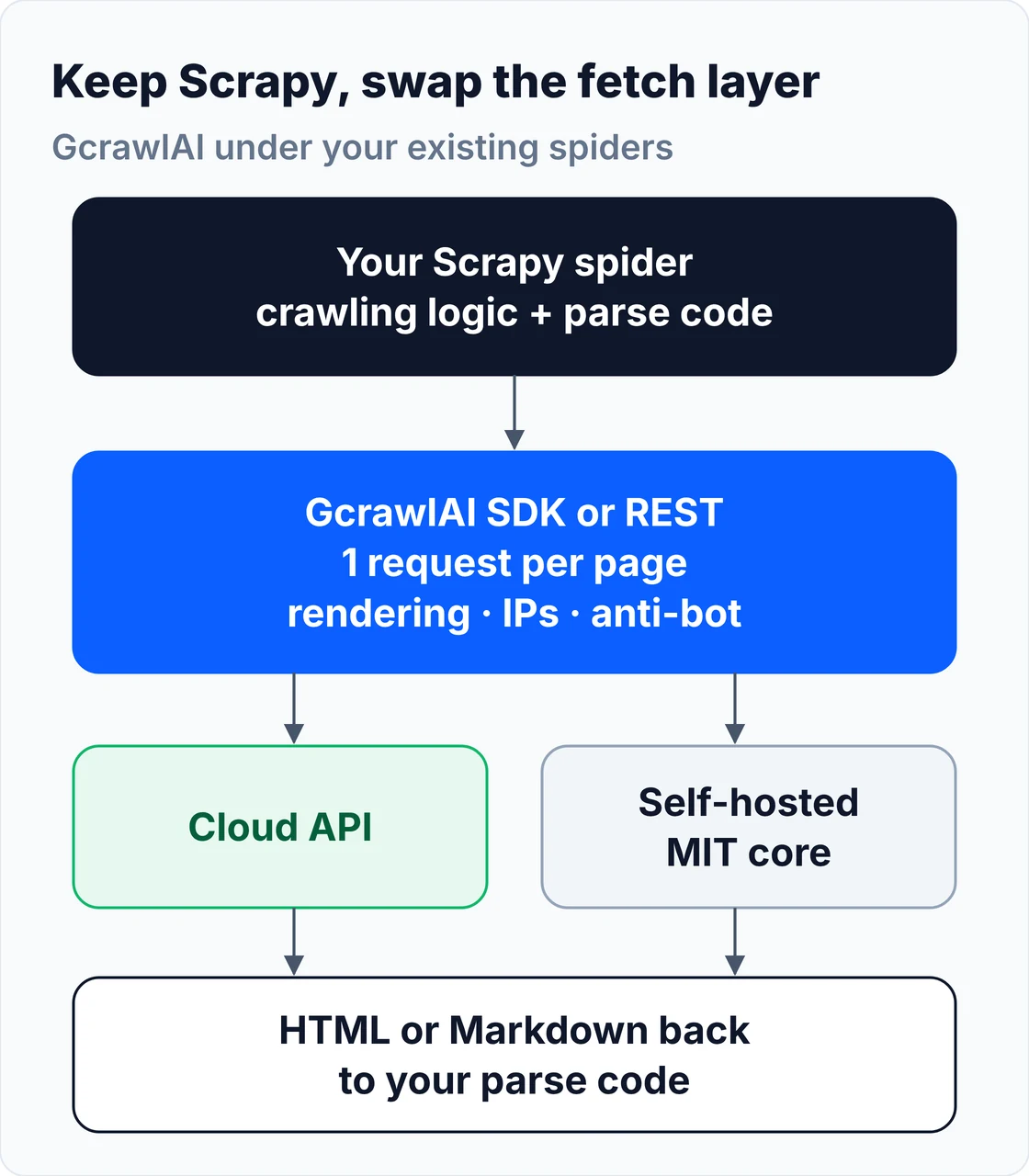
Scrapy users don't have to give up their spiders. The rendered HTML from GcrawlAI goes into the same parse code, so you can keep Scrapy for crawling logic and use GcrawlAI as the fetch layer.
And the self-hosted core, if the data must stay on your own servers:
git clone https://github.com/GramosoftAI/GcrawlAI.git && cd GcrawlAI
python -m venv .venv && source .venv/bin/activate
pip install -r requirements.txt && playwright install
cp .env.example .env                      # add your database, Redis and proxy settings
python -m api.core.db_setup
redis-server &
celery -A web_crawler.crawler.celery_config worker -l info &
uvicorn api.api:app --port 8000
Pricing (GcrawlAI pricing, checked October 28, 2026):
| Plan | Price | Requests/month | Per 1,000 |
|---|---|---|---|
| Free | $0 forever, no card | 50 | – |
| Starter | $29/month | 20,000 | $1.45 |
| Growth (most popular) | $79/month | 80,000 | $0.99 |
| Pro | $199/month | 250,000 | $0.80 |
| Scale | $499/month | 750,000 | $0.67 |
| Enterprise | Volume pricing | 2M+ | Custom |
| Self-hosted | $0 (MIT) | Your servers | Infrastructure only |
Every page is one request on every site, failed requests are never charged, and unused requests on paid plans roll over once. Annual billing gives two months free. Concurrency and overage rates are in the cost section below.
Where it falls short: there's no hosted spider platform like Scrapy Cloud; you run your own crawler or use GcrawlAI's crawl endpoint. There's no plain-English extraction parameter, so structured data comes from the extractors, Markdown for your LLM, or your own selectors. There are no dedicated Amazon or Walmart endpoints yet, the ecosystem is younger than Zyte's, and self-hosting means bringing your own proxy accounts.
"Teams tell us the hardest part of a Zyte bill isn't the rate, it's not knowing the rate until the job has run. We wanted the opposite: one price per page, on every site, that you can put in a budget before you start."
Rajesh Kannan, Co-Founder & CTO at Gramosoft
2. ZenRows: fixed multipliers you can model
Best for: teams who want to know the cost of a hard page before they send it · Type: scraping API with Fetch, Extract, Crawl, Batch and Browser primitives, SDKs and an MCP server
ZenRows prices by features used, not by site. A page costs the same multiplier wherever it lives, so you can work out a worst-case bill in advance. Its adaptive mode starts cheap and only escalates when a site needs it. We compared it in detail in our ZenRows alternatives guide.
Pricing (ZenRows pricing, checked October 27, 2026):
| Plan | Price/month | Credits |
|---|---|---|
| Free | $0 | 5,000 a month |
| Build | $19 to $39 | 45,000 to 120,000 |
| Launch | $69 to $129 | 250,000 to 700,000 |
| Growth | $199 to $399 | 1.2 million to 3 million |
| Request type | Credits per page |
|---|---|
| Standard | 1 |
| JavaScript rendering | 5 |
| Premium proxy | 10 |
| JavaScript + premium proxy | 25 |
Failed requests aren't charged, but 404 and 410 responses count as successful. Annual billing charges 10 months for 12.
Where it falls short: a rendered page on premium proxies costs 25 times a plain one, and credits don't roll over.
3. Bright Data: one flat rate per request
Best for: enterprise teams that want a flat price and a large proxy network · Type: Web Unlocker API on a proxy network, plus browsers, scrapers and datasets
Bright Data's Web Unlocker charges the same rate for every successful request, whatever the site. That makes it the simplest enterprise option to budget, at a higher base rate than Zyte's Tier 1. We cover its wider range in our Bright Data alternatives guide.
Pricing (Unlocker pricing, checked October 27, 2026):
| Plan | Price | Requests included | Per 1,000 |
|---|---|---|---|
| Free tier | $0 | 5,000 a month | – |
| Pay as you go | Usage only | – | $1.50 |
| Scale | $499/month | 383,000 | $1.30 after that |
Only successful requests are billed.
Where it falls short: there's no plan between pay as you go and $499 a month, and the product catalogue takes time to learn.
4. ScraperAPI: structured e-commerce and search data
Best for: high-volume Amazon, Google and Walmart scraping · Type: scraping API with structured endpoints, async jobs and DataPipeline
ScraperAPI prices by domain type rather than by tier. The credit cost of each category is published, so a bill is easier to forecast than Zyte's, though protected pages still cost many times a plain one.
Pricing (ScraperAPI pricing, checked October 27, 2026):
| Plan | Price/month | Credits | Concurrent threads | Geotargeting |
|---|---|---|---|---|
| Hobby | $49 | 100,000 | 20 | US and EU |
| Startup | $149 | 1,000,000 | 50 | US and EU |
| Business | $299 | 3,000,000 | 100 | Global |
| Scaling | $475 | 5,000,000 | 200 | Global |
| Page type | Credits per page |
|---|---|
| Standard page | 1 |
| Amazon | 5 |
| Google and Bing | 25 |
| 30 | |
| Cloudflare, DataDome or PerimeterX bypass | +10 |
Annual billing takes 10% off, and the trial gives 5,000 credits for 7 days.
Where it falls short: Hobby and Startup only geotarget the US and EU, credits don't roll over, and the credit cost of JavaScript rendering on its own isn't on the pricing page.
5. Scrapfly: built for the hardest targets
Best for: sites behind strong bot protection, and multi-step flows in a hosted browser · Type: scraping, extraction, screenshot and crawler APIs, a cloud browser and an MCP server
Scrapfly is the closest match to Zyte's depth on protected sites, with an Unblocker, and a cloud browser for Playwright and Puppeteer. Like Zyte, the cost of a request depends on what it needs.
Pricing (Scrapfly pricing, checked October 27, 2026):
| Plan | Price/month | Credits |
|---|---|---|
| Free | $0 | 1,000 |
| Discovery | $30 | 200,000 |
| Pro | $100 | 1,000,000 |
| Startup | $250 | 2,500,000 |
| Enterprise | $500 | 5,500,000 |
Pro and above switch to pay-as-you-go overflow instead of stopping, and the Unblocker page says failed requests are free.
Where it falls short: per-feature credit costs aren't on the pricing page, so forecasting needs its estimator. That's why it isn't in our cost table.
6. Apify: a home for existing Scrapy spiders
Best for: teams moving Scrapy spiders off Scrapy Cloud, or targets that already have a maintained Actor · Type: cloud Actor platform with scheduling, storage, proxies and webhooks
Apify can run Scrapy spiders as Actors without a rewrite, and its store has ready-made scrapers for many popular sites. It's the nearest replacement for the hosting half of Zyte, rather than the API half.
Pricing (Apify pricing, checked October 27, 2026):
| Plan | Price/month | What you get |
|---|---|---|
| Free | $0 | $5 of usage a month |
| Starter | $19 | Prepaid usage |
| Scale | $199 | Prepaid usage |
| Business | $999 | Prepaid usage |
Compute units cost $0.20 down to $0.13, residential proxies $8 down to $7 per GB, and unused usage expires each cycle.
Where it falls short: the cost of a page depends on how each Actor is built, so it doesn't compare cleanly with a per-request API.
7. ScrapingBee: a simple HTML API
Best for: small teams that want an easy API with extraction rules · Type: scraping API with JavaScript rendering, proxies, screenshots and AI extraction
ScrapingBee keeps the request simple: one URL, a few flags, HTML or JSON back. It's now part of the Oxylabs group, and its plans are unchanged. We covered it in depth in our ScrapingBee alternatives guide.
Pricing (plans, credit costs, checked October 27, 2026):
| Plan | Price/month | Credits |
|---|---|---|
| Free trial | $0 | 1,000 (once) |
| Freelance | $49.99 | 250,000 |
| Startup | $99.99 | 1,000,000 |
| Business | $249.99 | 3,000,000 |
| Business+ | $599.99 | 8,000,000 |
| Request type | Credits per page |
|---|---|
| No JavaScript | 1 |
| JavaScript (the default) | 5 |
| Premium proxy | 10 (25 with JavaScript) |
| Stealth proxy | 75 |
Where it falls short: a hard page on stealth proxies costs 75 times a plain one, and the free credits are a one-time trial.
8. Crawlbase: pay only for successful requests
Best for: variable workloads where a usage bill beats a monthly bucket · Type: Crawling API, async Crawler, Smart AI Proxy and storage
Crawlbase is framework-agnostic: one HTTP call per page from any language, with rotation, rendering and CAPTCHA handling on its side. Only successful requests are charged, and the price per request falls as volume grows.
Pricing (Crawlbase pricing explained, checked October 27, 2026):
| Usage | Standard requests, per 1,000 |
|---|---|
| Free start | 5,000 requests, no card |
| First 1,000 requests | $3.00 |
| Past 11,000 requests | $0.60 |
| Higher volume | Lower again |
Where it falls short: JavaScript requests and harder domains cost more, at rates the article doesn't publish, so a bill is hard to forecast before you run it.
9. Firecrawl: Markdown for LLMs
Best for: pages that go straight into a model or vector store · Type: scrape, crawl, map and search API with an AGPL open-source core
Firecrawl returns clean Markdown by default and prices most pages at one credit. It suits AI pipelines more than classic e-commerce extraction. We compared it with GcrawlAI in our Firecrawl alternatives guide.
Pricing (Firecrawl pricing, billing docs, checked October 27, 2026):
| Plan | Price/month | Credits |
|---|---|---|
| Free | $0 | 1,000 a month |
| Hobby | $19 | 5,000 |
| Standard | $99 | 100,000 |
| Growth | $399 | 500,000 |
JSON output adds 4 credits, and pages that return 403 or 404 still cost a credit.
Where it falls short: credits are scarce per dollar at the low end, and unused credits don't roll over below annual Scale.
How Zyte pricing works
Zyte charges per successful response, at a rate set by the tier it assigns each website. There are five tiers for HTTP responses and five for browser-rendered ones. You don't pick the tier: Zyte assigns it after your first requests to a site, reviews it every quarter, and gives two weeks' notice of changes.
| Plan | HTTP, Tier 1 to 5 (per 1,000) | Browser, Tier 1 to 5 (per 1,000) |
|---|---|---|
| Pay as you go | $0.13, $0.23, $0.44, $0.70, $1.27 | $1.01, $2.01, $4.02, $8.04, $16.08 |
| $100/month commitment | $0.10, $0.17, $0.33, $0.53, $0.95 | $0.75, $1.50, $3.00, $6.00, $12.00 |
| $200/month commitment | $0.08, $0.14, $0.26, $0.42, $0.76 | $0.60, $1.20, $2.40, $4.80, $9.60 |
| $500/month commitment | $0.06, $0.11, $0.21, $0.34, $0.61 | $0.48, $0.96, $1.92, $3.84, $7.68 |
Source: Zyte pricing and Zyte API pricing docs, checked October 28, 2026.
- Spending limits: pay as you go is capped at $100 a month. The $100, $200, $350 and $500 commitments raise the limit to $200, $400, $700 and $2,500.
- Extras cost more: screenshots are $1.34 per 1,000, automatic extraction $0.27 to $1.07 per 1,000 per data type (SERP extraction is free), and custom attributes are billed per million tokens.
- Billing: only successful responses are charged, and new accounts get $5 of credit for the first month.
- Scrapy Cloud (pricing docs): one free low-resource unit with 1-hour jobs and 7-day retention, or $9 per unit a month with unlimited runtime and 120-day retention.
What 10,000 and 100,000 rendered pages a month cost
For the same rendered page, Zyte costs between $100 and $768 at 100,000 pages a month, depending on the tier it assigns the site. GcrawlAI costs $101 on any site. The table shows the cheapest published plan for each tool, for pages that need JavaScript and bot protection.
| Tool (how a protected, rendered page is billed) | 10,000 pages/month | 100,000 pages/month |
|---|---|---|
| GcrawlAI (1 request, any site) | $29 (Starter) | $101 (Growth + overage) |
| Zyte, Tier 1 browser site | $10.10 (pay as you go) | $100 ($100 commitment) |
| Zyte, Tier 5 browser site | $120 ($100 commitment) | $768 ($500 commitment) |
| Bright Data Web Unlocker ($1.50 per 1,000) | $15 | $150 |
| Firecrawl (1 credit) | $99 (Standard) | $99 (Standard) |
| ScrapingBee (premium proxy + JavaScript, 25 credits) | $49.99 (Freelance) | $249.99 (Business) |
| ScrapingBee (stealth proxy, 75 credits) | $99.99 (Startup) | $599.99 (Business+) |
| ZenRows (JavaScript + premium proxy, 25 credits) | $69 (Launch 250K) | $399 (Growth 3M) |
| ScraperAPI (protected page, 11 credits) | $149 (Startup) | $299 (Business) |
These are list prices, not a benchmark. Free tiers are left out, including Bright Data's 5,000 free requests a month. Zyte's pay-as-you-go plan stops at $100 a month, so larger jobs use the cheapest commitment that covers them. Scrapfly, Apify and Crawlbase are left out because their cost for a rendered, protected page isn't published as a fixed rate.
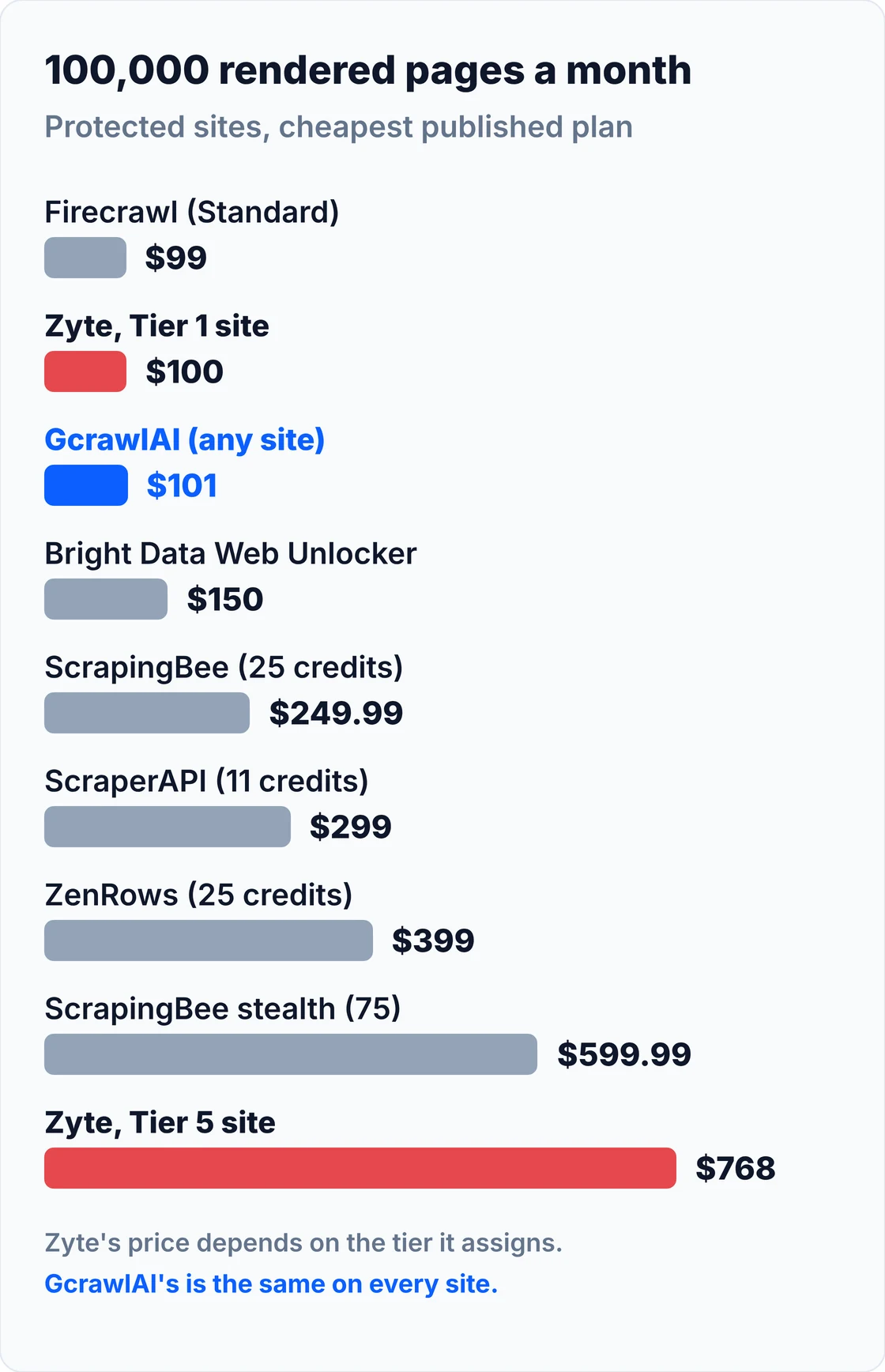
On a Tier 1 site, Zyte is cheaper than GcrawlAI at 10,000 pages, and so are Bright Data and, at 100,000 pages, Firecrawl. The difference is that GcrawlAI's price doesn't move with the site. If a Zyte site is reassigned from Tier 1 to Tier 5, the same 100,000 pages go from $100 to $768. On GcrawlAI they stay at $101.
GcrawlAI's plans, for the cost section above:
| Plan | Price | Requests/month | Concurrent | Per 1,000 | Overage per 1,000 |
|---|---|---|---|---|---|
| Free | $0 forever, no card | 50 | 2 | – | – |
| Starter | $29/month | 20,000 | 10 | $1.45 | $1.60 |
| Growth (most popular) | $79/month | 80,000 | 35 | $0.99 | $1.10 |
| Pro | $199/month | 250,000 | 50 | $0.80 | $0.90 |
| Scale | $499/month | 750,000 | 100 | $0.67 | $0.75 |
| Enterprise | Volume pricing | 2M+ | Custom | – | – |
| Self-hosted | $0 (MIT) | Your servers | Your servers | Infrastructure only | – |
Annual billing charges 10 months for 12, unused requests on paid plans roll over once, and Indian customers are billed in INR with a GST invoice. Full details are on the pricing page.
"We're not always the cheapest line in the table, and we say so. What we promise is that the line doesn't move. A page costs the same on a simple site and a protected one, this quarter and next."
Rajesh Kannan, Co-Founder & CTO at Gramosoft
Why teams leave Zyte
Teams rarely leave Zyte because it can't get through. They leave because the bill is hard to predict, because they don't want their stack built around Scrapy, or because they need an AI-ready output on one simple plan. These are the reasons that come up most often in reviews and forum threads.
- Tier pricing: the rate for a site isn't known until Zyte assigns its tier, and it can change each quarter. Browser rates span 16 times from Tier 1 to Tier 5.
- Spending limits: pay as you go stops at $100 a month, so any serious volume means a monthly commitment.
- Add-ons: screenshots, automatic extraction and custom attributes are billed on top of the request.
- Scrapy gravity: Zyte fits best when your crawlers are Scrapy spiders on Scrapy Cloud. Teams working in other languages or frameworks get less from the ecosystem.
Which Zyte alternative should you choose?
Start with why you're leaving Zyte. If it's an unpredictable bill, use GcrawlAI. If you want the data on your own servers, self-host GcrawlAI's MIT core. If you need LLM-ready Markdown, AI agent access or structured extractors, GcrawlAI covers those too. The table maps the common cases.
| If you need… | Pick | Why |
|---|---|---|
| A price per page you can budget | GcrawlAI | One request per page on every site, failed requests free |
| Protected and JavaScript-heavy sites | GcrawlAI | Rendering, residential IPs and anti-bot escalation in every request |
| Keep Scrapy for crawling logic | GcrawlAI as the fetch layer | Rendered HTML from the SDK or REST API goes into your existing parse code |
| Data on your own servers | GcrawlAI self-hosted | MIT core, no per-page fee |
| Pages for an LLM or RAG pipeline | GcrawlAI | Clean Markdown or JSON from the same request |
| AI agents on the live web | GcrawlAI | MCP server, Search API and Deep Search on one account |
| Enterprise volume and invoicing | GcrawlAI Enterprise | 2M+ requests a month, volume pricing, custom concurrency and extractors, INR or USD invoices |
When Zyte is still the right choice, and when GcrawlAI is
Zyte still makes sense for a narrow set of teams: those whose spiders already live on Scrapy Cloud, and those who depend on its automatic extraction or managed data feeds. For everything else, from protected sites and bulk crawls to AI agents, GcrawlAI does the work on one key, at one request per page.
Keep Zyte only for:
- Spiders already running on Scrapy Cloud that you don't want to host yourself.
- Zyte's automatic typed extraction or its managed Zyte Data feeds.
Use GcrawlAI for the rest. Here's what one account gives you:
- Scrape: any URL as HTML, Markdown or JSON, with JavaScript rendering, residential IP rotation and stealth escalation in the same single request.
- Crawl and map: a whole site with depth control and duplicate filtering, or its URL list without rendering every page.
- Batch and async jobs: thousands of URLs in one job, with results by webhook.
- Search API and Deep Search: ranked results by country and page, and several engines merged into one list.
- Extractors: ready-made structured data, and custom extractors for your own sites.
- Screenshots and offline bundles: mobile, tablet and desktop captures, and offline HTML bundles for audits.
- Built for AI agents: an MCP server for Claude, Cursor and other agents, plus the Python SDK and REST API.
- Try before you build: the Playground, and a Chrome extension that turns data you pick on a page into an API call.
- Your own servers: the MIT-licensed core runs self-hosted for teams whose data can't leave their network.
- Billing that doesn't move: one request per page, failed requests never charged, unused requests rolled over once, no tiers or per-site rates, and INR invoices with GST for Indian teams.
If you're on Zyte today, start with the free plan's 50 requests: run your hardest site through GcrawlAI, check the HTML, and compare the bill.
Scraping responsibly
Every tool on this list can reach protected pages, so how you use them matters. Collect public data, respect the terms that apply to you, keep request rates reasonable, and don't collect personal data you don't need. Nothing here is for getting past logins. See What Is Web Scraping? for the basics.
For the technical side of getting blocked, our guides on Cloudflare and 403 errors explain what's happening and what an API does about it.
Frequently asked questions
What is the best Zyte alternative?
For most teams, GcrawlAI. A page costs one request on every site, with rendering, residential IPs and anti-bot handling included, and failed requests are free. It comes with a Python SDK, an MCP server for AI agents and an MIT core you can self-host, so the price is known before the job runs.
How much does Zyte API cost?
On pay as you go, Zyte charges $0.13 to $1.27 per 1,000 HTTP responses and $1.01 to $16.08 per 1,000 browser-rendered ones, by the tier it assigns each site. Monthly commitments of $100 to $500 lower the rates, down to $0.06 and $0.48. Prices checked October 28, 2026.
Why is Zyte pricing hard to predict?
Because Zyte sets the tier for each website after your first requests, not before. There are five HTTP and five browser tiers, reviewed every quarter with two weeks' notice. The same page can cost from $1.01 to $16.08 per 1,000 when rendered, and you only know which once the site is assigned.
Is GcrawlAI open source, and can I use it commercially?
Yes. GcrawlAI's core is MIT-licensed on GitHub, so you can self-host it and use it commercially. The managed Cloud API adds hosted infrastructure, residential proxies, the Python SDK and MCP, with a free plan of 50 requests a month and paid plans from $0.67 to $1.45 per 1,000 requests.
Can I use GcrawlAI with Scrapy?
Is there a free Zyte alternative?
Yes. GcrawlAI has a free plan of 50 requests a month with no card, and its MIT core is free to self-host. ZenRows gives 5,000 credits a month, Bright Data 5,000 requests a month, Firecrawl 1,000 credits a month, and Crawlbase 5,000 free requests to start.
Does Zyte charge for failed requests?
No. Zyte's pricing docs say only successful responses are charged, and rate-limited or unsuccessful responses are free. GcrawlAI works the same way: blocked pages, CAPTCHAs, timeouts and server errors are never billed. What differs is the rate for a successful page, which on GcrawlAI doesn't depend on the site.