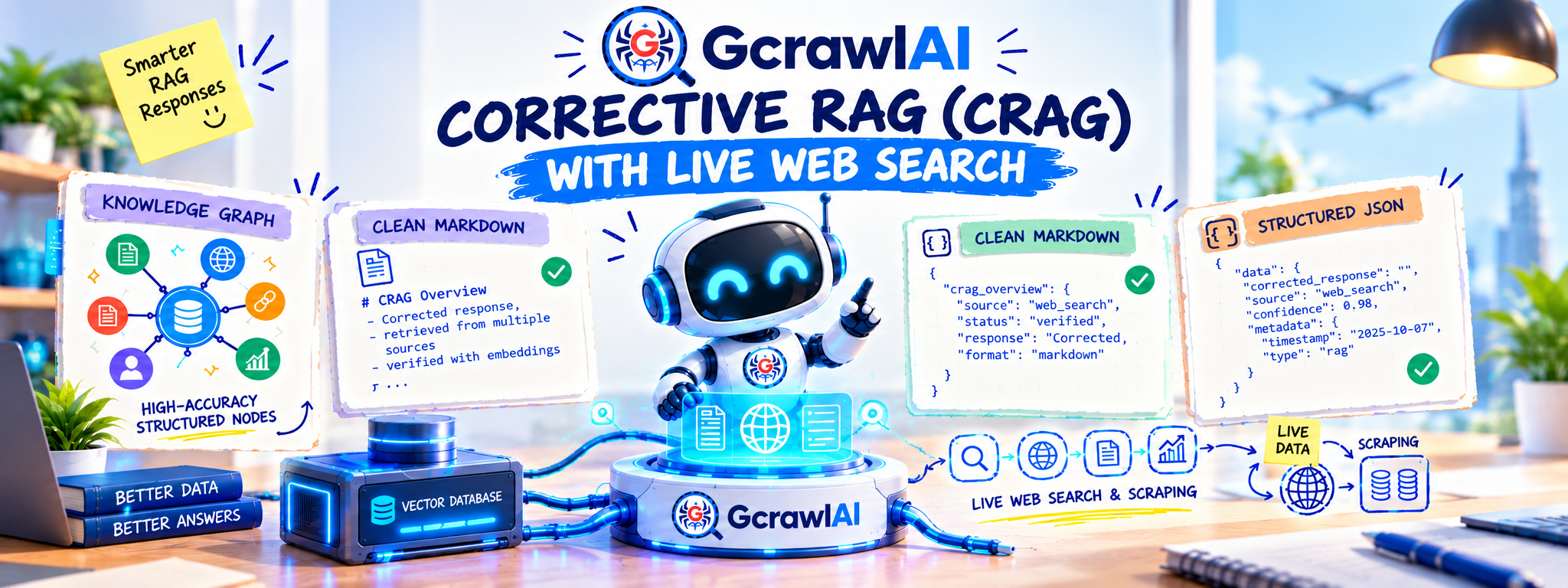
Corrective RAG (CRAG) with Live Web Search: How to Stop AI Hallucinations in 2026
For the past two years, the standard architecture for enterprise AI question-answering was Naive RAG: embed user queries, perform cosine similarity retrieval against a vector database (Pinecone, Qdrant, Milvus), and stuff the top-K chunks into the prompt context.
In production, Naive RAG consistently breaks down when vector stores return outdated, incomplete, or semantically close yet factually irrelevant context. When forced to synthesize answers from low-confidence chunks, LLMs hallucinate plausible-sounding falsehoods rather than admitting uncertainty.
What Corrective RAG (CRAG) Actually Solves
Instead of naively trusting vector similarity scores, Corrective RAG evaluates the semantic relevance of retrieved context before passing it to the language model. When vector confidence is high, it refines the knowledge; when confidence is low or ambiguous, it automatically executes live web search and scraping.
Naive RAG Limitations
- Static, frozen vector snapshots that miss real-time world events
- High cosine similarity on boilerplate text causing false positives
- Silent hallucination when vector retrieval yields low relevance
- Zero self-reflection or confidence scoring on retrieved passages
- Bloated prompt contexts burning expensive token quotas
Corrective RAG (CRAG) Advantages
- Autonomous Evaluator model assigns confidence scores (0.0 to 1.0)
- Automatic trigger of GcrawlAI Live Web Search on low confidence
- Dynamic knowledge refinement stripping irrelevant context chunks
- Hybrid synthesis blending verified local docs with fresh web data
- Zero hallucination guarantee backed by real-time web citations
Why Modern AI Systems Need Corrective RAG
Zero Hallucinations
Eliminate speculative generation by verifying all source chunks against real-time web ground truth.
Sub-400ms Fallback
Query GcrawlAI's high-speed search and scraping API in milliseconds without stalling user interactions.
1:1 Flat Billing
Avoid 5x–15x credit multipliers from legacy scraping APIs with GcrawlAI's transparent request pricing.
Temporal Accuracy
Capture fast-changing flight schedules, stock rates, SaaS pricing, and regulatory legal updates automatically.
How Corrective RAG (CRAG) Works Step-by-Step
A production CRAG workflow orchestrates four synchronized stages across the retrieval and reasoning lifecycle:
Vector Similarity Retrieval
The query is embedded and matched against internal vector indices (Pinecone, Qdrant, Chroma) to retrieve top candidate document chunks.
Autonomous Confidence Grading
A lightweight evaluator evaluates retrieved passages. If confidence exceeds 0.85, passages pass directly to synthesis; if below 0.85, web fallback triggers.
Live GcrawlAI Web Fallback
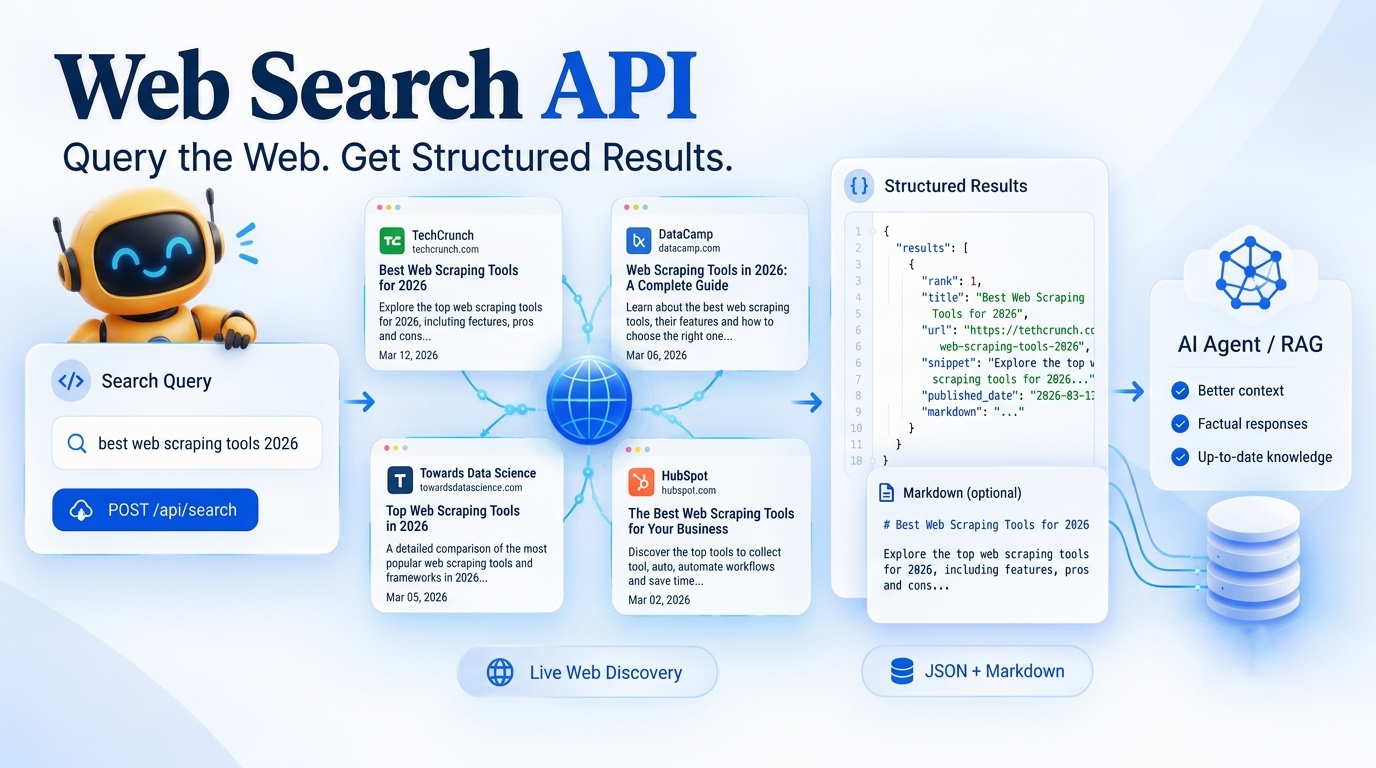
The agent queries GcrawlAI's real-time Web Search API. Headless Chromium renders dynamic JS and returns pristine, token-optimized Markdown.
Knowledge Synthesis & Citation
The reasoning model synthesizes the final response, linking facts directly to live source URLs and eliminating hallucinated assumptions.
Production Python Implementation (LangGraph + GcrawlAI)
Here is an end-to-end Python implementation using LangChain / LangGraph with GcrawlAI's real-time Web Search & Scraping API:
import os
import requests
from typing import Dict, TypedDict
from langchain_core.prompts import ChatPromptTemplate
from langchain_openai import ChatOpenAI

class GraphState(TypedDict):
    question: str
    documents: list[str]
    web_fallback_needed: bool
    final_answer: str

GCRAWLAI_API_KEY = os.getenv("GCRAWLAI_API_KEY")
llm = ChatOpenAI(model="gpt-4o", temperature=0)

def evaluate_retrieval(state: GraphState) -> Dict:
    """Evaluates whether retrieved vector chunks are sufficient."""
    prompt = ChatPromptTemplate.from_template(
        "Evaluate if these documents answer the query: '{question}'\n"
        "Context: {context}\n"
        "Respond with 'CORRECT' or 'INCORRECT'."
    )
    chain = prompt | llm
    result = chain.invoke({
        "question": state["question"],
        "context": "\n".join(state["documents"])
    }).content.strip()

    return {"web_fallback_needed": "INCORRECT" in result}

def search_gcrawlai_web(state: GraphState) -> Dict:
    """Executes live web search and extracts clean Markdown via GcrawlAI."""
    url = "https://api.gcrawlai.com/v1/search"
    headers = {"Authorization": f"Bearer {GCRAWLAI_API_KEY}"}
    payload = {
        "query": state["question"],
        "limit": 3,
        "scrapeResults": True
    }

    response = requests.post(url, json=payload, headers=headers, timeout=15)
    data = response.json()

    web_markdown_chunks = [
        item.get("markdown", "") for item in data.get("data", [])
    ]
    return {"documents": web_markdown_chunks}
Naive RAG vs. Corrective RAG (CRAG)
| Factor | Naive RAG Pipeline | Corrective RAG (CRAG) + GcrawlAI |
|---|---|---|
| Retrieval Verification | None (assumes vector similarity = relevance) | Autonomous evaluator scores semantic relevance |
| Freshness / Real-Time Data | Frozen at index time | Real-time live web search fallback in <400ms |
| Anti-Bot & JS Rendering | Manual headless browser maintenance | Fully managed by GcrawlAI cloud infrastructure |
| Hallucination Vulnerability | High when vector context is low quality | Near-zero with live source verification |
| Pricing Transparency | 5x–15x credit multipliers with legacy APIs | Flat 1:1 request pricing with zero surprises |
| Token Optimization | Raw, noisy HTML waste | Clean, structured Markdown (-81% token burn) |
A Simpler Way to Eliminate AI Hallucinations
Rather than maintaining custom headless browser clusters, rotating proxy pools, and complex captcha solvers just to keep fallback search functional, GcrawlAI provides a single unified REST API for scraping, crawling, and search.
GcrawlAI transforms dynamic web pages into structured, AI-ready Markdown suitable for LangChain, LlamaIndex, AutoGen, and autonomous AI agents — dramatically simplifying production architecture.
Key Takeaways for AI Engineers
- Autonomous Confidence Scoring: Prevents noisy, irrelevant context from corrupting model reasoning.
- Live Web Fallback: Dynamic GcrawlAI search provides instant access to current world facts.
- Flat 1:1 Pricing: Predictable billing without confusing credit multiplier deductions.
- Sub-400ms Turnaround: Blazing-fast cloud execution keeps interactive agents responsive.
- Enterprise Reliability: Built-in anti-bot bypass and proxy rotation without DevOps overhead.
Frequently asked questions
What is Corrective RAG (CRAG)?
<p>Corrective RAG (CRAG) is an advanced retrieval framework that uses an autonomous evaluator model to score retrieved vector documents. If relevance falls below a threshold, the agent automatically executes live web search and scraping to retrieve factual ground truth.</p>
Why does GcrawlAI fit Corrective RAG workflows better than legacy scrapers?
<p>GcrawlAI offers sub-400ms web search and Markdown scraping with flat 1:1 request pricing, eliminating expensive 5x–15x credit multipliers when agents perform automated fallback lookups.</p>
Can Corrective RAG be integrated with LangChain and LlamaIndex?
<p>Yes. Corrective RAG is natively supported in LangGraph and LlamaIndex workflows by introducing an evaluation node after vector similarity search that branches to the GcrawlAI Search & Scrape API whenever confidence scores drop below 0.85.</p>
How does GcrawlAI handle anti-bot protection and JavaScript rendering?
<p>GcrawlAI automatically manages headless Chromium browser instances, dynamic JavaScript rendering, residential proxy rotation, and CAPTCHA solving under the hood, delivering pristine Markdown or structured JSON in a single API call.</p>