Automated B2B Lead Scraping & Enrichment: How to Build a High-Volume Prospecting Pipeline with GcrawlAI
Modern B2B sales teams face a silent budget drain: paying $500 to $3,000+ every month for static contact databases like ZoomInfo, Apollo, or Cognism, only to discover that over 30% of emails bounce, phone numbers are disconnected, and job titles are months out of date.
Top revenue teams, hyper-growth startups, and outbound agencies are replacing pre-packaged databases with live, automated web lead enrichment pipelines. Instead of buying stale lists that your competitors are already spamming, automated scraping allows you to monitor live company websites, extract decision-maker signals in real time, and enrich your CRM on demand.
The True Cost of Legacy Database Subscriptions vs. Live Web Scraping
Why are revenue leaders transitioning from traditional list vendors to autonomous scraping engines? The comparison comes down to freshness, data depth, and unit economics:
❌ Traditional B2B List Databases
- High Annual Contracts: $6,000 to $25,000/year minimum commitments.
- Stale Intelligence: Verified once every 6–12 months; high email bounce rates.
- Shared Lists: The same prospects receive identical cold pitches from hundreds of vendors.
- Limited Technographics: Shallow categorization based on outdated survey data.
✅ Live Scraping Pipeline (GcrawlAI)
- Real-Time Accuracy: Directly extracts current leadership, pricing tiers, and active job openings.
- Transparent 1:1 Pricing: 200 free monthly requests, Developer plans from ₹1,587 ($19/mo) for 20,000 requests.
- Zero Credit Multipliers: Headless JavaScript rendering and residential proxies included at 1 request.
- Proprietary Edge: Target niche directories, state registries, and industry associations competitors cannot access.
Architecture of an Enterprise AI Lead Enrichment Pipeline
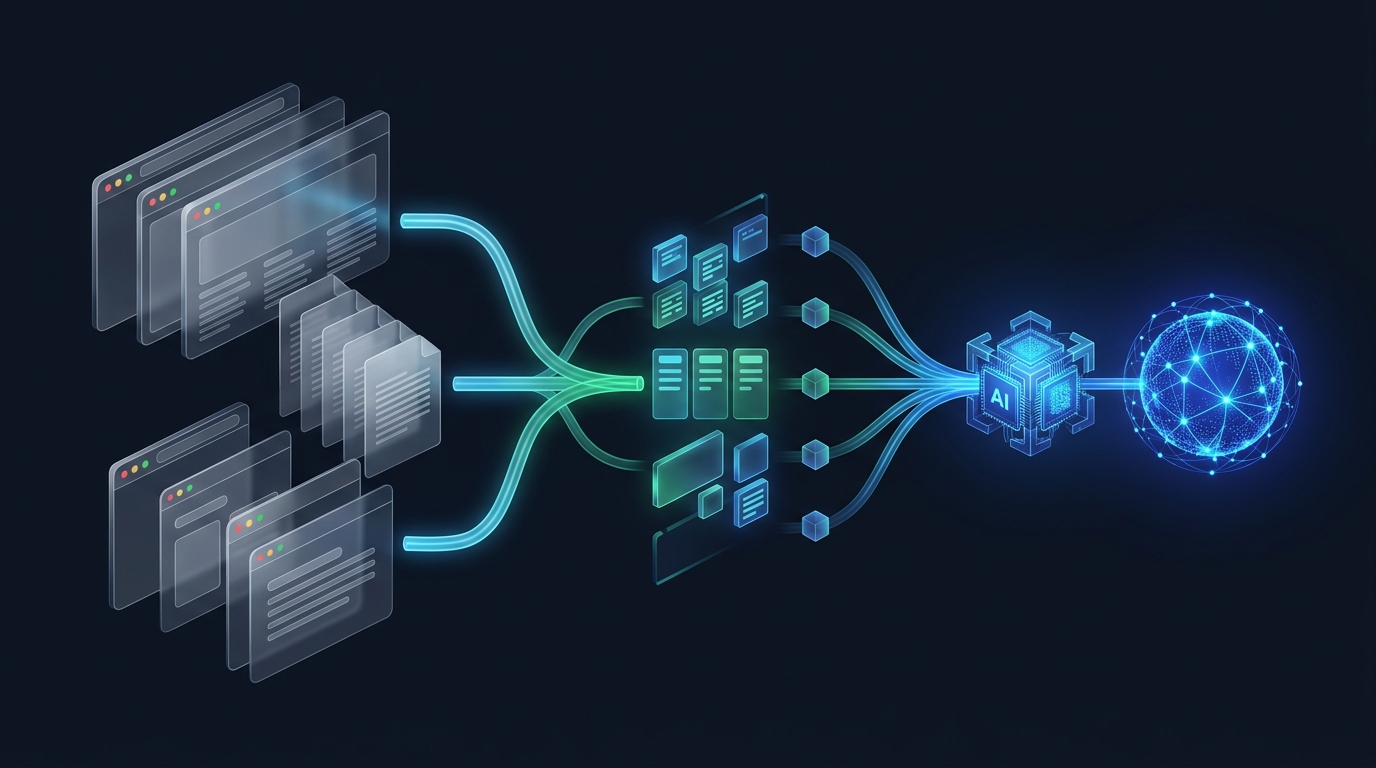
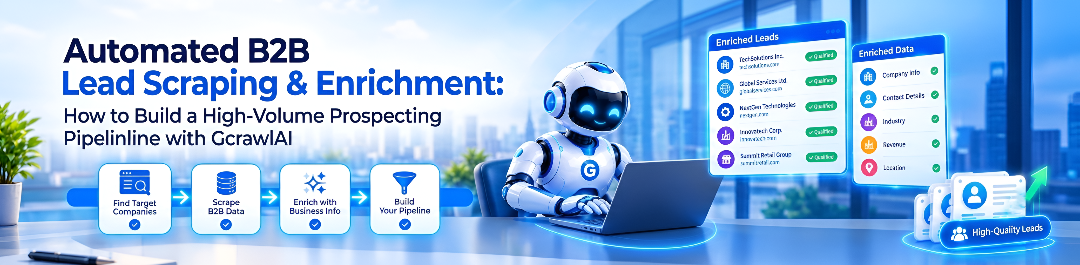
An automated prospecting engine operates in four synchronized stages, converting raw company domain names into highly qualified, personalized outbound campaigns:
- Target Account Discovery: Ingesting initial company domains from search engines, niche directories, or product hunt launches using GcrawlAI /map and /search.
- Deep Surface Crawling: Traversing the company’s
/about,/team,/pricing, and/careerspages with automated JavaScript rendering and anti-bot evasion via GcrawlAI /scrape. - AI Entity Extraction: Passing the high-signal Markdown output into an LLM (Claude 3.5 Sonnet, GPT-4o, or Gemini 1.5 Pro) to extract key contacts, current tech stack, headcount ranges, and recent press milestones into structured JSON.
- CRM & Outreach Sync: Pushing enriched company records directly into HubSpot, Salesforce, or Lemlist for personalized, high-converting cold outreach.
Building Your Lead Enrichment Engine in Python (Step-by-Step)
Below is a production-ready Python script that takes a target company URL, deep-scrapes their core pages using GcrawlAI, and extracts structured firmographic data and decision makers ready for sales outreach:
import os
import json
import requests

GCRAWLAI_API_KEY = os.getenv("GCRAWLAI_API_KEY", "YOUR_GCRAWLAI_API_KEY")

def enrich_company_profile(domain_url: str):
    """
    Enriches a target company profile by scraping its About and Team pages
    using GcrawlAI's headless JavaScript rendering and clean Markdown extractor.
    """
    endpoint = "https://api.gcrawlai.com/v1/scrape"
    headers = {
        "Authorization": f"Bearer {GCRAWLAI_API_KEY}",
        "Content-Type": "application/json"
    }

    # 1. Scrape Homepage & About page with main content isolation
    payload = {
        "url": domain_url,
        "formats": ["markdown"],
        "onlyMainContent": True,
        "waitFor": 1500,
        "country": "us"
    }

    print(f"[*] Extracting live intelligence from {domain_url}...")
    response = requests.post(endpoint, json=payload, headers=headers, timeout=40)

    if response.status_code != 200:
        print(f"[!] Scrape failed: {response.text}")
        return None

    data = response.json()
    markdown_content = data.get("data", {}).get("markdown", "")
    page_title = data.get("data", {}).get("title", "")

    print(f"[+] Scraped {len(markdown_content)} characters of clean Markdown (0 credits wasted).")

    # In a full pipeline, feed markdown_content into an LLM with structured output:
    enriched_record = {
        "domain": domain_url,
        "company_name": page_title.split("|")[0].split("-")[0].strip(),
        "raw_markdown_summary": markdown_content[:500] + "...",
        "status": "ENRICHED"
    }

    return enriched_record

# Example Run
if __name__ == "__main__":
    company_data = enrich_company_profile("https://example.com")
    print(json.dumps(company_data, indent=2))
Why Legacy Web Scrapers Fail at High-Volume Lead Generation
When engineering teams try building lead generation scrapers using legacy tools like Firecrawl, ScrapingBee, or Crawlbase, they hit three major bottlenecks:
1. The "Credit Multiplier" Trap
Most modern SaaS and B2B websites are single-page applications (SPAs) built with React, Webflow, or Next.js. They require headless browser rendering and residential IP rotation to avoid instant Cloudflare or DataDome blocking. Legacy scrapers charge 5x to 25x credits per request for JS and proxies. A planned 10,000-lead run consumes 50,000 to 250,000 credits, unexpectedly depleting monthly quotas in days.
The GcrawlAI Difference: GcrawlAI charges strictly 1 Request = 1 Request. JavaScript execution, anti-bot stealth, and rotating residential proxies are included standard on every request.
2. Token Bloat & Hallucinations in LLM Extraction
Feeding raw HTML into LLMs wastes thousands of unnecessary tokens on CSS stylesheets, SVG graphics, nested navigation headers, and tracking scripts. With onlyMainContent: true, GcrawlAI strips page noise and returns clean, semantically intact Markdown. This reduces token consumption by up to 80%, lowering LLM API costs while drastically boosting extraction accuracy.
3. IP Bans & Fingerprint Tracking
B2B directories actively fingerprint scrapers using TLS ciphers (JA4), Canvas rendering hashes, and behavioral mouse heuristics. GcrawlAI incorporates a tiered stealth engine that escalates through evasive browser fingerprints automatically, guaranteeing over 99.2% extraction success rates across protected enterprise domains.
Unit Economics: How GcrawlAI Saves Up to 85% on Lead Generation
Let’s compare the monthly cost of enriching 50,000 target company websites across common options:
| Provider / Strategy | Pricing Model | Credits / Multiplier | Estimated Monthly Cost |
|---|---|---|---|
| Apollo / ZoomInfo Enterprise | Per-seat license + credit limits | Stale database access | $800 – $2,500 / mo |
| Firecrawl / ScrapingBee (JS Enabled) | Credit system (5x–15x multiplier) | 250K–750K credits burned | $300 – $600 / mo |
| GcrawlAI Growth Plan | Flat 1:1 Request Billing | Zero Multipliers (50K Req) | ₹7,900 ($95 / mo) |
Getting Started: Enrich Your First 200 Leads for Free
Ready to build a reliable, high-volume prospecting pipeline? You can test your enrichment workflow today without writing complex scrapers or paying for enterprise database licenses:
- Test live URLs in the interactive GcrawlAI Playground to inspect instant Markdown conversions.
- Review our dedicated Lead Enrichment Solutions Page.
- Sign up for a free developer account at gcrawlai.com/app and receive 200 free monthly requests with full JavaScript rendering and residential proxy support.
Frequently asked questions
Is web scraping for B2B lead generation legal and compliant?
<p>Yes. Extracting publicly accessible business information from company websites (such as company descriptions, public contact emails, executive bios, and pricing) is standard practice and fully compliant with international data regulations when respected under reasonable request rates. GcrawlAI processes target web data ephemerally in RAM and complies with India DPDPA 2023 and EU GDPR without storing personal data.</p>
How does GcrawlAI handle anti-bot protection on B2B directories?
<p>GcrawlAI features an automated tiered stealth browser architecture combined with premium residential proxy pools. It automatically neutralizes Cloudflare Turnstile, DataDome, and PerimeterX challenges behind a single API call, requiring zero manual browser configuration.</p>
Why is GcrawlAI significantly cheaper than ScrapingBee or Firecrawl for lead enrichment?
<p>Legacy APIs impose 5x to 25x credit multiplier penalties when you enable JavaScript rendering or residential proxies. GcrawlAI charges strictly 1 Request = 1 Request regardless of page complexity, reducing your monthly extraction costs by up to 80% at scale.</p>
How many leads can I enrich on the free plan?
<p>The GcrawlAI free plan includes 200 requests every month forever. Every request includes headless JavaScript rendering, Markdown conversion, and anti-bot bypass with zero credit deductions.</p>