
How Large-Scale Web Crawling Powers AI Applications
Imagine giving your AI access to information from 10,000 websites.
Instead of answering questions using only its trained knowledge or a small collection of documents, your AI could continuously collect information from websites, extract useful content, organize it, and make that data available for search, analytics, automation, RAG systems, and AI agents.
That is the idea behind large-scale web crawling.
The key idea
Large-scale crawling is not simply about downloading more pages. It is about building a reliable pipeline that discovers, extracts, cleans, structures, and delivers web data to applications.
What Is Large-Scale Web Crawling?
Web crawling is the automated process of discovering and visiting web pages to collect information.
At small scale, this might mean crawling a few hundred pages. At large scale, the system may need to process thousands of websites and millions of URLs.
- Thousands of websites
- Millions of URLs
- Dynamic JavaScript pages
- Product catalogs
- Documentation
- Blogs and news
- Business directories
- Knowledge bases
Why Would an AI Need to Read Thousands of Websites?
AI systems are only as useful as the information available to them. A language model can generate an answer, but many business applications require information that is current, domain-specific, and frequently updated.
Web crawling creates a bridge between AI models and external information.
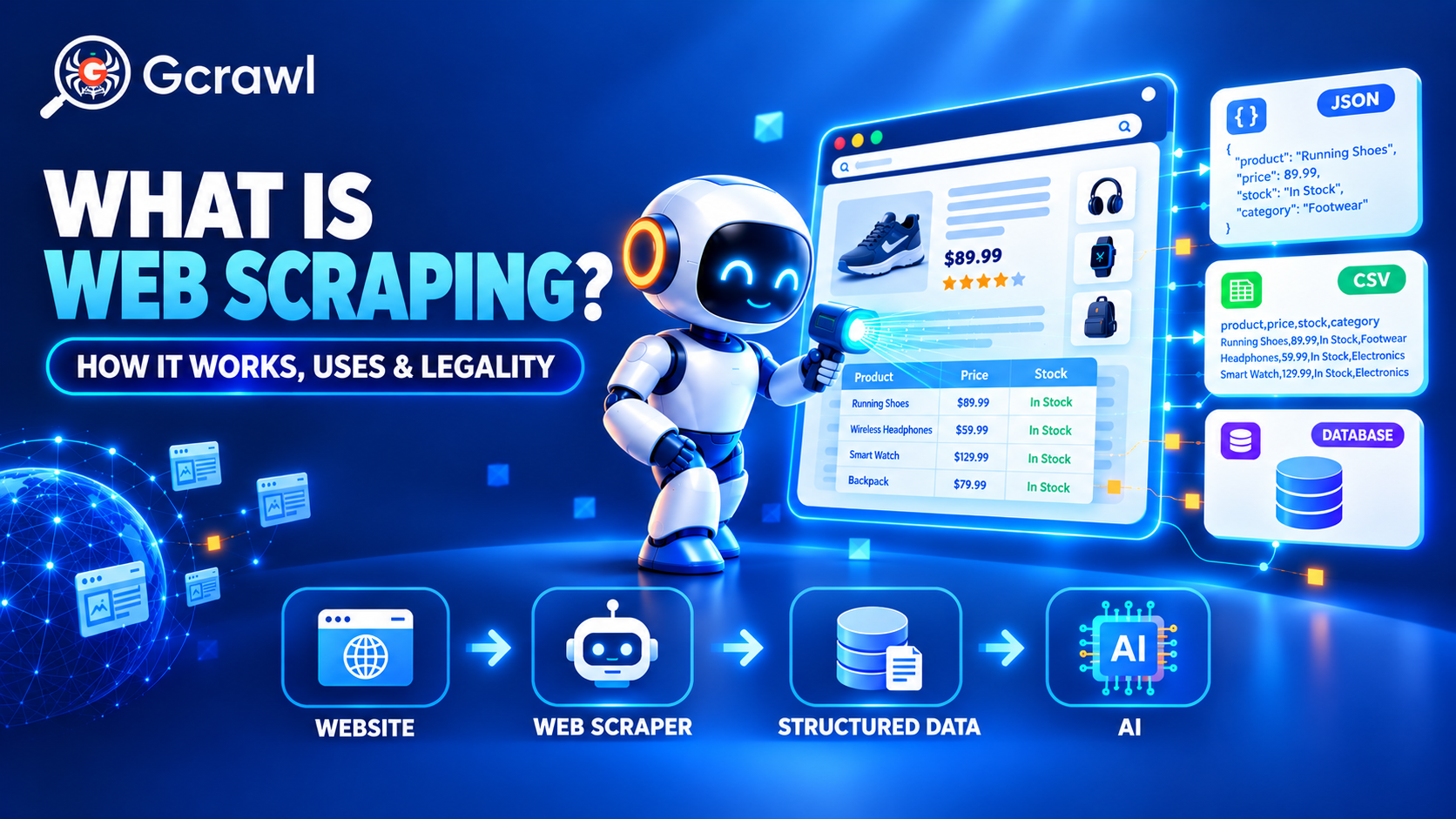
Web Crawling vs. Web Scraping
The terms web crawling and web scraping are often used interchangeably, but they describe different parts of the data collection process.
A simple way to think about it is: crawling finds the pages, while scraping extracts the data.
The Architecture Behind Large-Scale Web Crawling
A reliable crawling platform usually consists of several components working together.
Handling JavaScript-Heavy Websites
One of the biggest challenges in modern web crawling is JavaScript rendering.
A traditional HTTP request may return HTML that does not contain the information visible in a browser. Modern websites often load their content dynamically after JavaScript executes.
A browser-based crawler can load a page, execute JavaScript, wait for dynamically generated content, and then extract the rendered information.
Large-Scale Crawling for RAG
Retrieval-Augmented Generation, commonly called RAG, is one of the most important applications for web crawling.
This allows an AI application to work with information that can be updated independently of the underlying language model.
Web Crawling for AI Agents
AI agents increasingly need access to external information. An agent may need to search, retrieve, compare, analyze, summarize, and act on information from multiple websites.
What Can You Build With Large-Scale Web Crawling?
Competitive Intelligence
Track competitor products, pricing, features, documentation, content, and announcements.
Price Monitoring
Monitor product prices, availability, and changes across multiple websites.
Lead Enrichment
Collect publicly available company information and transform it into structured profiles.
AI Knowledge Bases
Convert website content into searchable knowledge for RAG applications and AI assistants.
Research Automation
Collect information from large numbers of sources for research and analysis workflows.
AI Training Data
Build datasets from appropriately sourced web content for research and machine-learning workflows.
The Biggest Challenges in Large-Scale Crawling
1. Rate Limiting
Websites may restrict how frequently requests can be sent. Crawlers need appropriate throttling and domain-level concurrency controls.
2. Duplicate Content
The same content can sometimes appear at multiple URLs. URL normalization and content hashing can help reduce unnecessary processing.
3. Failed Requests
Networks fail, servers go offline, pages disappear, and requests time out. Production systems need retry policies and failure handling.
4. Dynamic Content
Some websites require JavaScript execution before useful content becomes available.
5. Crawl Traps
Filters, calendars, search pages, and URL parameters can create enormous numbers of URLs. Crawl controls are essential.
6. Data Quality
Successfully downloading a page does not necessarily mean the correct information was extracted. Validation matters.
Where GcrawlAI Fits
Building every component of production-grade web crawling infrastructure from scratch can require significant engineering effort.
GcrawlAI provides APIs designed to make web data collection easier to integrate into applications.Build with Web Data.
Build with Web Data
Connect crawling, scraping, search, and web data extraction directly to your applications.
From 10,000 Websites to an AI-Ready Data Pipeline
The Future of AI Is Connected to Live Data
Language models have changed how software interacts with information. But AI applications still need access to external, current, and domain-specific data.
Large-scale web crawling provides one way to build that connection.
The key shift
AI applications are moving beyond simply generating answers. They can increasingly find information, understand it, connect it, and use it to perform useful work.
Frequently asked questions
What is the difference between crawling and scraping?
Crawling focuses on discovering and visiting URLs, while scraping focuses on extracting useful information from those pages.
Can web crawling be used for RAG?
Yes. Website content can be crawled, cleaned, chunked, embedded, and indexed for retrieval-augmented generation systems.
Can AI agents use web crawlers?
Yes. AI agents can use search and crawling tools to discover information, retrieve page content, and analyze external sources.
How many websites can a crawler process?
There is no universal limit. Capacity depends on URL volume, crawl frequency, infrastructure, concurrency, page complexity, browser rendering, and website-specific restrictions.
Why is JavaScript rendering important?
Many modern websites generate content dynamically using JavaScript. Browser rendering can make that content available for extraction.
Is large-scale web crawling expensive?
Cost depends on crawl volume, rendering requirements, bandwidth, storage, infrastructure, and crawl frequency. Caching and deduplication can help reduce unnecessary work.
Is web crawling legal?
Requirements vary by jurisdiction, website, content, intended use, and applicable laws or contractual terms. Organizations should review relevant access restrictions, website policies, intellectual-property requirements, privacy obligations, and other applicable rules.